Favorite Photos

Favorite Photos
Bernini's Ecstasy of St. Teresa

Wednesday, August 31, 2011

Iconic Structures of Rome: The Fountain of Trevi

“Three coins in a fountain”.... a song that made many a young girl of my generation visiting Rome, fantasize about meeting someone as romantic as Rossano Brazi and having that perfect Roman holiday! For my mom it was Felinni's La Dolce Vita, with my teenage niece on the other hand, the movie was the Lizzie McGuire Movie with Hilary Duff. So the world moves on, movies and movie stars fade and new ones take their place but the Trevi Fountain remains what it has been, and may be for a long time to come, an iconic symbol of Rome.
Walking along the Via Corso, there are signs that point you to the more visited spots in Rome. One of these, closest to Piazza Venezia is the sign pointing to the Trevi Fountain. Following this sign in the straightest way possible in the twisting, narrow streets of Rome brought us to Via Stamperia where the sounds of water became more and more audible, letting us know that we were indeed approaching the Fountain. Following the sounds, we turned a corner and almost suddenly it’s there right in front of you...the Trevi Fountain!


The Piazza
The Piazza della Fontana Trevi is a rather small piazza and the Fountain itself is not in the center of the piazza but is actually built into the back of the Pallazo Polli. Because of its size, the number of people you encounter milling around the piazza can be quite overwhelming!


Ocean personified
The Trevi Fountain, the largest baroque fountain in Rome stands at the juncture of 3 waterways, the Aqua Virgine, the Aqua Virgo and one of the repaired ancient aqueducts, hence the name Trevi. The aqua Virgo was constructed by Marcus Vispanius Agrippa, Augustus Caesar's friend and ablest general and also the person who first built a structure on the spot where the Pantheon is today, still carrying his name on it's facade. In the 15th century a simple fountain was erected in this spot to mark the endpoint of the aqueduct as was the practice at the time. In the 17th century Pope Urban VIII asked Gian Lorenzo Bernini to make improvements on the fountain but the project was put on hold due to lack of funds.


Calm Waters
Actual work on this fountain only started in 1732 after Nicolo Salvi won a competition held by Pope Clement II to design the fountain. The funds for the building came from the third drawing of the Lotto game (yes the lotto!) in May 1732. It took Salvi almost 30 years to complete the project and he died in the process, his lungs completely damaged because of the time spent in the dank waterworks of the fountain.


Raging Waters
The fountain is 85.28 feet hight, 160.72 feet wide and spills 80,000 cubic meters of water a day. The facade is made of travetine blocks (from Tivoli) and the statues are of carrara marble. The main statue is a depiction of Ocean riding a shell chariot pulled by two sea horses. One of the horses is calm, the other, restless, signifying the fluctuating moods of the sea, with the water in the fountain representing the sea.


Bring us back to Rome
According to some, the custom of throwing coins in the fountain goes back to an ancient Roman tradition of throwing a coin into fountains, rivers and lakes at the start of a journey to ask the gods to favor the journey and to bring them back safely. However, the more cynical explanation is that someone in the city invented the tradition in order to raise funds for the maintenance of the fountain. Which was a brilliant plan as Wikipedia says around 30,000 euros (some italians don't believe this, saying that a lot of tourists toss in the "little" coin) a day is collected from the fountain!
We slowly made our way forward until we managed to squeeze in right to the front of the fountain, where we tossed the obligatory coins with our backs turned to the fountain. They say three coins held in the left hand and tossed over the right shoulder....or was it the other way around? Whichever way, We embraced the legend (after all this was not our first time to do this) and chose to believe that those coins will bring us back to Rome once again. And by the way, we contributed 3 euros to the total collection for the day!

Friday, August 26, 2011

Facciamo Cuocere.....Let's Cook.......fish!

My husband has never been very fond of tomatoes, removing tomatoes from his salad, not really enjoying food cooked in tomatoes, and preferring pesto or cream based sauces for his pasta. And like most Chinese, eats only rice or noodles with lunch and dinner, reserving bread for breakfast...maybe. But after over three months in Rome, I find that I am serving more and more baguette or dinner roles with our meals. He has also developed a taste for tomatoes, and all sorts of tomato based dishes. His favourites are tripe and bacalao.

Bacalao:

Bacalao stall Termini
Bacalao or salted cod is plentiful here in Rome. We first saw this in the market at Termini and we continue to buy our bacalao from this same vendor. Bacalao is sold in slabs that are about ½ - 1 inch thick, 3 – 6 inches wide and about 12 – 18 inches long. The first thing to do before cooking is to wash all the salt off and then soak it in water for 24-48 hours, remembering to change the water at least three times. The time I cooked this for my brother's family, when they came to visit, I forgot to do this and the cooked bacalao turned out quite salty! If it is very hot in your kitchen, you will need to refrigerate while it soaks. Once it’s ready to cook, remove the skin and the bones and cut them against the grain into cubes and dredge them in flour. I like simple recipes and here’s one way to cook bacalao Florentine style. You will need:

soaking bacalao
3 cloves crushed garlic
1 small onion minced
Pepper
White wine
¾ lb. canned or fresh tomatoes
chilli powder or chilli flakes


a slab of bacalao
 Saute the garlic and onions and then add the bacalao cubes turning them to cook on the other side as well. Put in the white wine and continue cooking until almost all the wine has evaporated, add the tomatoes, crushing them against the pan, add chilli powder and pepper to taste. And that’s it! This is delicious served with baguette! It is a dish that keeps really well and tastes better the next day. So don't worry about leftovers.... that is if there is any. 

Spigola baked in salt:


The first time I tried fish baked in salt was in Sestri Levanti almost 14 years ago during my parents' golden wedding anniversary celebration. It was delicious and not easily forgotten! Then just last month, I had turbot baked in salt at the Casina Veladier, a restaurant atop the Pincio Hill here in Rome. I really liked this and was determined to try doing this at home myself.

My husband loves steamed fish, the way the Chinese do it, which to him is the way fish should be cooked. He believes and I think he is right that this is healthier than frying and brings out the real flavor of the fish. My mother-in-law always steamed her fish and insisted on it's freshness. I remember her pointers: look at the eyes, they need to be clear and luminous, pinch the fish, it has to be firm to the touch and then sniff at it, it should have the smell of the sea! If the fish had a slight smell (a big no no) or was bought in the afternoon, she would say "no good" but would proceed to make a curry or fry the fish with chili so as "not to waste it". So when I decided to try the salt baking way, I knew I had to find the freshest fish possible.

Spigola or sea bass is one of the more popular fish sold in our supermarket. When I first tried this, I went to my friendly supermarket fish monger who advised me not to scale the fish. So he cleaned the inside of the spigola for me and left the scales on. Another time, I had forgotten to tell him that it was for salt baking so he scaled it before I could stop him. Either way it was ok. However, the unscaled fish came out looking nicer. The skin came out in a whole strip, so serving the meat was easier and made me look like an experienced maitre 'd.


spigola is in there somewhere
 The salt that I use is of the coarse variety. I use about a kilo mixed with 1 egg and some water until it resembled wet sand, the consistency resembling what one would use to build sand castles on the beach. The subsequent times I did this, I used only the egg white as the yolk gave the salt a yellowish color which was not very attractive.

First time I tried doing this, I was a bit uncertain, but found that it was really simple. First, stuff the cavity of the fish with some parsley and then on a baking dish, spread some of the salt, enough to hold the bottom of the fish securely. Encase the whole fish with the remaining salt and then put it in the oven (350 degrees F) for around 25 - 30 minutes.


yummy!
 When you remove this from the oven, the salt cover would have hardened. Using a wooden spoon or the flat side of a cleaver, crack the salt and free the fish. I simply bring the entire fish to the table with some sliced lemon. I skin the fish right at the table. Adding a bit of olive oil and or lemon is all that's needed. Tastes fantastic! Even my husband agreed, so he no longer keeps asking me to steam fish for dinner (I always had to say, we have no steamer or no pan big enough), salt baking has become a very good substitute. And to tell you frankly, I actually prefer this.

After having eaten fish this way a couple of times, I found out that cooking fish this way originated in Sicily. What do I know of Sicily? Well right now as I sit here writing this, I hear the theme song of the Godfather in the background! But this notoriety may only be scratching the surface. Goethe reputedly said, "To have seen Italy and not to have seen Sicily is not to have seen Italy at all, for Sicily is the clue to everything". Need to follow that clue...another side-trip to dream about!

Sunday, August 21, 2011

Chianti country...Wine, wine and more wine!

The month of August is a very slow, very hot month here in Rome. Offices continue to function but with “skeleton crews”, and in harmony with the somnolent days of the hottest part of summer.  The feast of the Assumption which falls on the 15th of August is a national holiday in Italy, and falling in the midst of vacation month, those who haven’t left yet, do so. My husband and I, being a bit tired of the quiet streets and closed restaurants decided to take a trip to Tuscany, specifically wine country, the Chianti area. I won’t call this the premier wine making region, (although Tuscans claim it to be), because Italians from other parts will surely think otherwise. And who am I to judge...being a foreigner and all. The one thing I am sure about is we, my husband and I, like to drink good wine and so it was with anticipation that we went to Florence with the express purpose of joining a wine tasting tour... ok maybe not only for that...

On the way to the winery, our very knowledgeable and entertaining guide gave us a history of what we know as the Chianti region. As she tells it, it was in the Middle Ages, in the heart of “Chianti Mountain” (in the hills between Florence and Sienna), that three towns, Gaiole, Castellina and Radda formed the League of Chianti which would form the heart of the Chianti wine region to this day. In 1716 Cosimo III de’ Medici, grand duke of Tuscany decreed that these three towns including Greve would be the only recognized producers of Chianti wine. This edict stood until 1932 when the Italian Government expanded the area to include other areas like the Barberino Val D’Elsa and others.

Today, the Chianti area is divided into 2 regions, the boundary running between Florence to the north composed of five zones (including the three original towns, Greve and Barberino Val D’Elsa), and Sienna to the south composed of two zones. You may wonder at the inequity of the division, well as legend would have it, a race between two riders starting when the cocks crowed would determine the borders. Sienna chose a well fed white rooster, while the Florentines chose a skinny black rooster. Sienna’s rooster overslept, and that as they say was that!  

Today the black rooster seal is placed on Chianti Classico wine bottles.

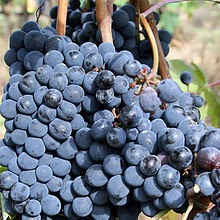
The main grape variety grown in the Chianti region is the Sangiovese grape, or as it is poetically called, Blood of Jove. As you can tell by the name, it is a rather dark purple grape. The dark skin of the grape (it is from the skin that the wine gets its color... at least that’s how I understood it) gives rise to a dark full bodied red wine. It is said that this variety originated in Mesopotamia and was first cultivated in the region by the Etruscans. The first Chianti wines were reputedly of the white variety, which slowly evolved into red wine. Bettino Ricasoli, an Italian statesman who went on to become one of the prime ministers of Italy has been credited with coming up with the formula for Chianti wines, a blend of 70% Sangiovese, 15% Canaiola, 15% Malvasia. Today, for it to be classified Classico, it must contain at least 80% Sangiovese.

With the economic and political upheavals in Europe, the poverty brought on by the Risorgimiento and the wiping out of vineyards due to epidemics, wine production suffered. After the war, a variety of Chianti wine known as fiasco became the most popular wine from the region and up to the 20th century, Chianti wine was associated with this squat bottle wrapped in a straw basket. When my family visited Italy in the 60’s and 70s this was the Chianti wine (the taverns also used these bottles as their candle stands) I remembered and it was only when I started to enjoy drinking wine with my husband did I realize that Chianti wine did not all come in this bottle.

Ever since we’ve arrived, we have enjoyed shopping for wine, Italian wine specifically because there is so much to choose from. We’ve also tried to learn a little bit more about what the regulatory labels mean. There are 4 of them. As I understand it, the first two, DOC or Denomination of Controlled Origin and DOCG or Denominazione di Origine Controllata e Garantita, guarantee that wines having this label attached to the bottles are made with sangiovese grapes and other local grapes from the Chianti region in the right kind of proportions and following all the rules as stipulated by the government and are therefore guaranteed to be of consistent quality. The difference is that DOCG wines have to pass a blind taste test and as such can be said to be the best of the best.

The next two designations can be attributed to the Italians' easy going nature and a certain disposition for “not following the rules”, or opting out of following them. IGT or Indicazione Geografica Tipica simply indicates where the wine is from and the VdLT are wines like the “Super Tuscans” which mix international variety of grapes like Merlot with Sangiovese.

Speaking about the Super Tuscans, in 1995 some producers were coming out with wines made from 100% Sangiovese. Production of these reduced significantly after 2004.


Chianti country


The bus ride to the wine tasting site which was in the Barberino Val D’Elsa area brought us into the heart of Chianti country, an area of rolling hills, olive groves and vineyards. We stopped at Fattoria Sant’Appiano, a family owned winery, charmingly laid out on top of a hill, and were welcomed graciously by the present Dona of the Capelli family, the present owners of the vineyard and winery since 1960. The vineyards themselves, we were told were one of the oldest in existence and were originally owned by the Pitti family, whose patriarch, Luca Pitti (1398-1472) was a staunch supporter of Cosimo de’ Medici.


One of the valves
 The daughter gave a short introduction as to how wine was made from picking the grapes and then putting them into this giant container where there are valves through which the wine is pumped out and put into the barrels. In the container, the mixture of mashed grapes, grape skin, seeds and branches are stirred regularly, in this way ensuring the coloration of the wine. They stay in this container for four weeks.

After four weeks, the skin etc. are separated by mechanical means, and the wine is transferred into the wine barrels made of different types of oak (from which the wine picks up some of its flavour and bouquet), where they remain for up to 24 months (for the Riserva). They also remain in the glass container for a while before it can be sold.


Entering the wine cellar
 We tasted 4 different wines, a Rose, a Chianti DOCG made up of 90% Sangiavese and 10% Merlot, a Chianti Superiore DOCG made with 100% Sangiovese and a Toscano Rosso Monteloro IGT made with 90% Sangiovese and 10% Colorino. When we were all a little happy, we were shown the cellars, with barrels and barrels of wine, happily aging away.


The Tunnel
On the way back to Florence, we took a side trip to Castellina, one of the original towns of the Lega Chianti, again charmingly set on top of another hill. We got there in the late afternoon, as the sun's heat was loosing it's ferocity. The townspeople were up and about, watching us tourists watching them, all this done with some amusement on both sides, I think. My husband and I chose to explore the tunnel, one of the three paths leading out of town to the main road.

There were many enotecas lining this route, selling wine grown around the area and proudly sporting the black rooster. We entered one of them and bought some more wine, forgetting that we already had bought four bottles waiting for us on the bus. Carrying all that on the train back to Rome would be a problem, something we failed to consider at the time.

Wednesday, August 17, 2011

Ancient Rome: The Roman Forum


I have been to the Roman Forum three times now but have had difficulty starting a blog about it. It became a difficult task I think because stepping into the Forum leaves one with so much to think about, but on the other hand there is disappointingly very little to see. It is difficult to reconstruct what was once there and more difficult to disregard the “mutilation” that is there. One cannot help but lament the result of years of “plunder” by popes and rulers that have left this place resembling the  emperor of the childrens' classic story, parading without a stitch of clothing, or...ok...just in his underwear!


The forum taken from the Tabularium


foundation of Romulus'Hut
Having said that, stepping into the Forum aroused echoes of school, memories of oratorical moments, and recapturing history and literature lectures of exceptional quality, rekindling for me once again interest and awe in all things Roman. There is something about  it (the Forum) that captures the imagination, standing on the spot where Romulus lived, walking down the same path that Cicero, Brutus, Marc Anthony et. al. trod on, and standing on the spot where Julius Caesar’s remains were entrusted to the heavens.   And so I stayed and came back again and again, going through the ruins and trying to see in my mind’s eye the way it was before.


The Forum is a rectangular plaza which began its existence as a marketplace. For centuries it was the center of Roman public life, the site of elections, triumphal parades, gladiatorial matches (before the coliseum was built), public trials, venue for speeches and rallies, in short “the teeming heart of ancient Rome”.

One enters the forum through the Via Sacra. Walking north toward the Capitoline Hill, one comes upon the Temple of Romulus on the right. It is a round temple still possessing its bronze doors, built by Maxentius, an opponent of Constantine in memory of his son Romulus. Behind this, Emperor Nerva built his Forum Pacis which was transformed in the middle ages, to the church of Saints Cosme and Damiano, thus saving it from destruction and "looting". 


In front of this temple was the site of the home of the Vestal Virgins, whose duty it was to tend the holy fire in the Temple of Vesta. Vesta was the goddess of the hearth fire, the center of the roman house and worshipped in the family circle. The temple guarded the “holy fire”, the symbol of the life of the city, and as such could not be allowed to die down. Every year, during spring cleaning time, embers from the old fire would be kept in order to re-kindle the fire anew.

This fire was tended by 6 Vestal Virgins. The Vestals were very important women, in that performance of their one and only task was tied to the continuity of the Roman state. This duty was considered of the utmost importance and so young girls from the most notable families were chosen from a very young age to become vestals. They were brought into service at the age of 6 to 10 years of age, underwent a 10 year training period and served for 30 years. They took a vow of chastity which had to be adhered to until the term of service ended. Some of them never left the temple, choosing to live out their lives as vestals, some left the temple and even married and had children. However, if a vestal broke this vow of chastity while still a vestal, the punishment was “entombment”, being buried alive.

All that remains of the House of the Vestals is  the rectangular courtyard with a tiny pool in the middle and statues of past Vestale Maximates (head vestals) around it. To the sides are remains of the rooms which these women stayed in. Apparently some of them are very well preserved unfortunately, they are not opened to the public. This area has a nice, tranquil feel about it, grass covered the courtyard around the square pool and creepers and flowers dotted the walls and the garden. In front of the House of the Vestals is the Temple of Vesta, a white circular structure. 

Just in front of the House of the Vestal Virgins to the right lie the remains of the Regia. This is one of the oldest structures in the Forum, said to be built by Numa one of the first kings. This was the residence of the kings and then became the lodging place of the Pontifex Maximus, the highest priest in the board of Pontifices tasked among other important duties, with making the calendar, namely designating dates when events, celebrations and other important aspects of daily life could take place.


In front of the Regia, one sees what remains of the Temple of Caesar, built by Augustus to honor the deified Julius Caesar. The temple was built on top of the spot where his remains were cremated after his assassination, which occurred not at the Curia in the Forum, as is commonly thought, but at the Curia in the Theatre of Pompey. Today only the foundations are visible, and these are covered by a small wooden structure topped by GI sheets. Inside, some people still leave flowers and other tributes on the mound, and tour guides recite in sonorous voices Shakespeare’s, “I’ve come to bury Caesar, not to praise him!”

Just beside the Temple of Romulus is the Temple of Antoninus and Faustina, which was built by Antoninus in memory of his wife Faustina. This was later (7th or 8th century AD) converted into a church and as such avoided the destruction suffered by other buildings around it. Today it is known as the Church of San Lorenzo in Miranda.

Beside the House of the Vestal Virgins are found three columns, all that remains of the Temple of Castor and Pollux, built in 484 BC and used not only as a temple but for military ceremonies, senate rituals and also a place where many plans and initiatives were discussed or undertaken.

Fronting the Temple of Castor and Pollux are the ruins of the Basilica of Aemilia built in 179 BC, which consisted  of 2 levels. In the 5th century, as the legend goes, in this place, Lucius Verginius stabbed his daughter to death to prevent her from becoming a slave of Appius Claudius who desiring her, had by nefarious means, while her father was away at war, managed to have her declared his slave. This same Appius Claudius was one of the forbears (and the skeleton in the closet) of the Claudii, one of ancient Romes's most powerful families.

Near the Temple of Castor lie the ruins of the Basilica Julia, (the rectangular area seen here  behind  the arch of Septimus Severus) started by Julius Caesar and finished by Augustus Caesar. This functioned as a court where civil cases (centumviri) were heard. There were 45 chambers and the public was allowed to attend these sessions. Lawyers on both sides encouraged partisans to attend these sessions in the hopes of influencing the outcome by their vociferous support. You can imagine how raucous some of the sessions became. This burnt down in the 9th century AD.


Near the Basilica Aemilia is the Curia Julia (the rectangular building) which goes back to 300 AD. This is the final form taken by the Curia which had been built and burned four times in its history. Caesar began building this and it was completed by Augustus. This was where the senators met. Two hundred senators at a time could be accommodated in the curia, seating on rows of seats along the long side of the Curia (today busts and statues are exhibited along this wall). The building still stands, but its huge bronze door now serves as the front door of the Cathedral St. John Lateran.

Beside the Curia is the Tullianum or the Mamertime prison which has two floors. The upper floor was where prisoners were kept and the lower floor was where they were executed. Enemies of Rome like Jugurtha from Africa, Vercingetorix from Gaul, the Gracchi brothers and the accomplices of Catilina were imprisoned and executed here. Two other prisoners of note were St. Peter and St. Paul. This is the main reason why the Church of St. Peter in Prison (on the right) was built over this jail. You can still go into this notorious place for the price of 5 Euros.

Toward the southernmost part of the Forum stands the Arch of Septimus Severus (behind the columns of Castor and Pollux) which was to commemorate this emperor’s triumphs in the east. He was father to Caracalla, a cruel ruler who in turn built the famous baths of Caracalla.

North of the Basilica Julia is the Temple of Saturn, one of the most respected monuments in ancient Rome and the place where the Saturnalia was held, a celebration of great importance to honor Saturn Cronos, the youngest of the Titans and the father of Jupiter, Rome's primary god. This was a week long celebration where schools were called off, presents exchanged and gambling was allowed even to the slaves. Today all that’s left of this temple are some columns.

The Temple of Concordia is found on the top of the forum. This was inaugurated in 366 BC as a symbol of reconciliation between the plebes and the patricians following a law passed guaranteeing that one of the 2 consuls would be from the ranks of the plebes. There is hardly anything left of this today.

Beside the Temple of Concordia are the ruins of the Temple of Vespacian (seen here from the Tabularium). This was built by Domitian to honor his father and his brother Titus.

Behind the Temple of Concordia is the Tabullarium, which contained the Roman public records office. On top of this was the aerarium or treasure house of the Temple of Saturn. Today this is part of the Capitoline Museum, opened to the public and one can take a picture of the entire ancient site from its windows.


It is tiring to walk the ruins of the Forum especially in the heat of the summer. However, even for someone with very high expectations of the place like myself, and despite the initial dissapointment, doing it is rewarding. As I walked away from the Forum (the third time) in the direction of the Palatine Hill, I realized I had fallen victim to the magic of the place. The hours had passed unnoticed and I needed sometime to reorient myself to the present.

Thursday, August 11, 2011

Churches: Sainte-Chapelle in Paris

I wanted to go into the Notre Dame Cathedral during our weekend in Paris but was unable to. But fortuitously, for no other reason but because we got off the metro at La Cite, we decided to go into the Sainte-Chapelle. You may wonder why I say it was fortuitous? Simply because, the Sainte Chapelle is a jewel of a church! (I don’t say this lightly as I have visited tons of churches here in Rome).

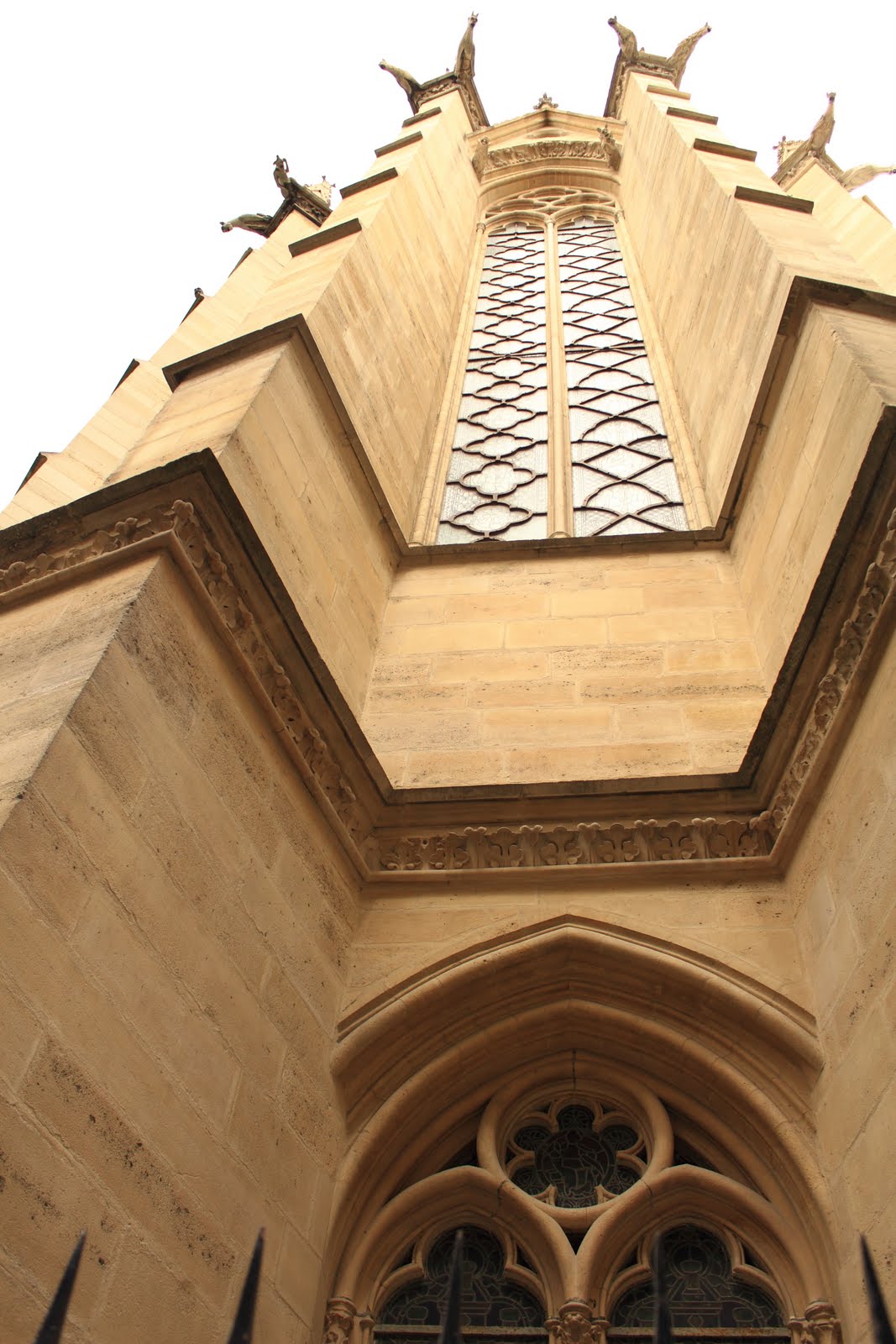
The Sainte-Chapelle was built by Louis IX, canonized by the church and now known as St. Louis, to house the relics of the Holy Passion. He built this on the site of the king’s residence, the Palais de la Cite’ which was began by his grandfather, Philippe Auguste. Sainte-Chapelle was damaged during the revolution but restorations carried out between 1840 and 1868 restored the building to it’s thirteenth century appearance.

In 1239, Louis IX bought from Baudoin II de Courtenay the Franc emperor of the east (after the capture of Constantinople by the Crusaders in 1204), who was in need of money for military purposes, the Crown of Thorns worn by Christ during the Passion for 130,000 livres (a considerable amount in any age). He then deposited the Crown of Thorns in the Chapel of St. Nicholas, close to the Palais de la Cite. Two years later he also bought a fragment of the Cross as well as other relics connected with the Passion. It may have been these purchases that inspired Louis IX to build a reliquary to house these precious relics. Thus the idea of the Sainte-Chapelle reliquary was born.


The work on this may have began in 1244. The Sainte-Chapelle is a Gothic (i.e. with the towering spires etc.) Palatine (a palace) chapel composed of two stories of identical surface areas but differing heights. The first floor was the palace chapel, open to the king's soldiers, courtiers in residence and servants. The lower chapel is dedicated to the Virgin Mary and you enter it through the Portal of the Virgin.

The entrance hardly prepares one for what awaits inside. Stepping in you find yourself surrounded by color, specifically blue, red and gold. The columns are red and gold, the walls are painted a kind of terracota red, and the ceiling is a brilliant blue, studded with three pronged leaves of gold, absolutely stunning!


The blue, red and gold paintwork of the ceiling emphasizes the star pattern of the tops of the columns where each tip corresponds with the fall of a rib of the vault. Under the coloumns are statues and in the center of the bays are painted medallions of the apostles brightened by gilded plaster.

To reach the upper chapel, one needs to climb a very narrow corkscrew staircase. As one needs to watch where one is going, it is at the last step where one can look up, and is confronted by a marvelous sight! The top chapel is amazing in its dimension, its soaring ceiling and the thousand sparkling colored lights coming through the stained glass windows. The lower walls are painted with the same colors as the lower chapel. There are no upper walls, only glass which gives it an ethereal lightness. The ceiling is a replica of the lower chapel. When one looks up at this, surrounded by light, one gets the impression that one is looking up at the sky. It is truly awe-inspiring!

The stained glass windows depict different Christian themes. The one right behind the main altar for example depicts scenes from the Passion, the first one on the left closest to the entrance depicts the story of the Relics of the Passion stored here in the past. And the Rose window depicts the Apocalypse.

In the center, one sees the main altar and on top of the altar is the relics platform, no longer containing the relics for which it was intended. The Sainte-Chapelle was built for worshipping by someone who was familiar with man`s need for this, and who also knew how best to encourage, or awaken this need. As I sat there in the top chapel, people around me were seated quietly, some contemplating the guides identifying the stained glass window, others just sitting there, as awed as I was.