Favorite Photos

Favorite Photos
Bernini's Ecstasy of St. Teresa
Showing posts with label Chianti. Show all posts

Monday, April 16, 2012

The Beauty of Chianti!

A good friend, originally from Milan who had moved with his wife to Sienna and raised his family there, invited us to stay with them for a couple of days. Being at the tail end of our Roman adventure, we accepted with alacrity.

We were going to take a train, which meant going to Florence first and then from there taking another train to Sienna. Our friend advised us to take the bus instead which  offered a more direct route. We took the bus from Rome's Tiburtina bus station, located just beside the Tiburtina Metro stop.  In just under 3 hours we were pulling into the bus station in Sienna, where our friend was waiting for us.

Our friend lives in the outskirts of Sienna, right in the middle of the Chianti countryside, Tuscany's crowning glory. In under 6 minutes, driving along a winding two lane street through vineyards and olive groves, we reached his place, a converted medieval chapel, with an ancient olive tree guarding the entrance.


The facade is untouched, as Siennese law prohibits the
alteration of structures like these. Indoors, everything is modern but the original walls are as they were. Everything inside is built away from these walls, therefore, the steel frame that supports the rooms, the floors etc. of the inside is built around a foot from the original walls.

The back door at dawn

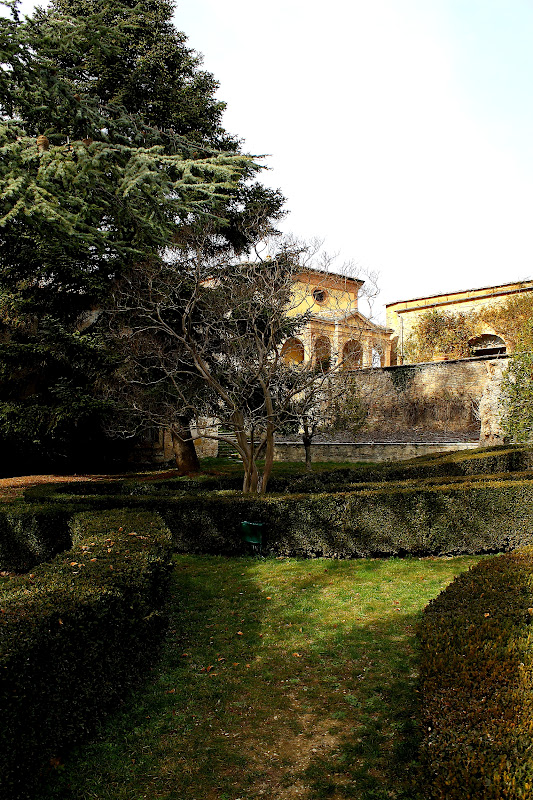
Because building on land in and around this area is prohibited, one is afforded panoramic views of the Chianti countryside.


Before dinner that night, our friend took us on a tour of his olive grove, which he had harvested in October. He has a small grove judging by the standards of his neighbors, this being merely a hobby for him.

walking in between his olive trees
an ancient olive press
Handpicked olives are brought to the village press, then bottled as extra virgin olive oil.

We were to taste this later and I have to say it was delicious, and the best I have ever had! With its decidedly greenish tint and a slightly nutty tang, I dare say my friend's olive oil cannot be found anywhere in any market in the world!

Walking back to the chapel, we passed by this ancient olive tree beside an ancient shrub of rosemary.

The ancient, gnarled olive trees, the dormant grape vines, the intermittent hooting of the resident owl, the fragrance of rosemary mingling with the rather chilly early evening breeze made for an impressive not to be forgotten experience! But there was more to come!

That night, our host served us a leg of spring lamb cooked on a spit in his stone fireplace. As we waited for the lamb to cook, we sat around the fireplace, enjoying the warmth and sharing a  delicious Chianti!  The lamb was accompanied by a mixed green salad from his vegetable garden and some artisan bread dipped in his delicious olive oil.


a villa
a hotel
The next day, our host brought us for a drive around the Chianti countryside. Poets, painters, artists as well as ordinary visitors and even harassed tourists, past and present, who have come to Tuscany, and more specifically Chianti country, have never failed to fall in love with her! I was lulled by the beauty of the passing countryside, impressed by the large imposing villas and their formal gardens, thrilled by picturesque family ran hotels and tickled pink by humorous displays like these:

giant figures along the Chianti roadside

And then there is Sienna! (I will write about our visit to this beautiful place in my next blog).

We stayed 3 nights with our friend, and when it was time for us to return to Rome, we needed to wake up early to catch the morning bus. As we hurried out the front door, we were treated to this glorious view of the rising sun:


Sunday, August 21, 2011

Chianti country...Wine, wine and more wine!

The month of August is a very slow, very hot month here in Rome. Offices continue to function but with “skeleton crews”, and in harmony with the somnolent days of the hottest part of summer.  The feast of the Assumption which falls on the 15th of August is a national holiday in Italy, and falling in the midst of vacation month, those who haven’t left yet, do so. My husband and I, being a bit tired of the quiet streets and closed restaurants decided to take a trip to Tuscany, specifically wine country, the Chianti area. I won’t call this the premier wine making region, (although Tuscans claim it to be), because Italians from other parts will surely think otherwise. And who am I to judge...being a foreigner and all. The one thing I am sure about is we, my husband and I, like to drink good wine and so it was with anticipation that we went to Florence with the express purpose of joining a wine tasting tour... ok maybe not only for that...

On the way to the winery, our very knowledgeable and entertaining guide gave us a history of what we know as the Chianti region. As she tells it, it was in the Middle Ages, in the heart of “Chianti Mountain” (in the hills between Florence and Sienna), that three towns, Gaiole, Castellina and Radda formed the League of Chianti which would form the heart of the Chianti wine region to this day. In 1716 Cosimo III de’ Medici, grand duke of Tuscany decreed that these three towns including Greve would be the only recognized producers of Chianti wine. This edict stood until 1932 when the Italian Government expanded the area to include other areas like the Barberino Val D’Elsa and others.

Today, the Chianti area is divided into 2 regions, the boundary running between Florence to the north composed of five zones (including the three original towns, Greve and Barberino Val D’Elsa), and Sienna to the south composed of two zones. You may wonder at the inequity of the division, well as legend would have it, a race between two riders starting when the cocks crowed would determine the borders. Sienna chose a well fed white rooster, while the Florentines chose a skinny black rooster. Sienna’s rooster overslept, and that as they say was that!  

Today the black rooster seal is placed on Chianti Classico wine bottles.

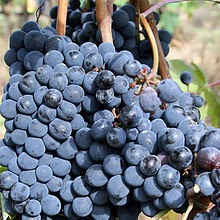
The main grape variety grown in the Chianti region is the Sangiovese grape, or as it is poetically called, Blood of Jove. As you can tell by the name, it is a rather dark purple grape. The dark skin of the grape (it is from the skin that the wine gets its color... at least that’s how I understood it) gives rise to a dark full bodied red wine. It is said that this variety originated in Mesopotamia and was first cultivated in the region by the Etruscans. The first Chianti wines were reputedly of the white variety, which slowly evolved into red wine. Bettino Ricasoli, an Italian statesman who went on to become one of the prime ministers of Italy has been credited with coming up with the formula for Chianti wines, a blend of 70% Sangiovese, 15% Canaiola, 15% Malvasia. Today, for it to be classified Classico, it must contain at least 80% Sangiovese.

With the economic and political upheavals in Europe, the poverty brought on by the Risorgimiento and the wiping out of vineyards due to epidemics, wine production suffered. After the war, a variety of Chianti wine known as fiasco became the most popular wine from the region and up to the 20th century, Chianti wine was associated with this squat bottle wrapped in a straw basket. When my family visited Italy in the 60’s and 70s this was the Chianti wine (the taverns also used these bottles as their candle stands) I remembered and it was only when I started to enjoy drinking wine with my husband did I realize that Chianti wine did not all come in this bottle.

Ever since we’ve arrived, we have enjoyed shopping for wine, Italian wine specifically because there is so much to choose from. We’ve also tried to learn a little bit more about what the regulatory labels mean. There are 4 of them. As I understand it, the first two, DOC or Denomination of Controlled Origin and DOCG or Denominazione di Origine Controllata e Garantita, guarantee that wines having this label attached to the bottles are made with sangiovese grapes and other local grapes from the Chianti region in the right kind of proportions and following all the rules as stipulated by the government and are therefore guaranteed to be of consistent quality. The difference is that DOCG wines have to pass a blind taste test and as such can be said to be the best of the best.

The next two designations can be attributed to the Italians' easy going nature and a certain disposition for “not following the rules”, or opting out of following them. IGT or Indicazione Geografica Tipica simply indicates where the wine is from and the VdLT are wines like the “Super Tuscans” which mix international variety of grapes like Merlot with Sangiovese.

Speaking about the Super Tuscans, in 1995 some producers were coming out with wines made from 100% Sangiovese. Production of these reduced significantly after 2004.


Chianti country


The bus ride to the wine tasting site which was in the Barberino Val D’Elsa area brought us into the heart of Chianti country, an area of rolling hills, olive groves and vineyards. We stopped at Fattoria Sant’Appiano, a family owned winery, charmingly laid out on top of a hill, and were welcomed graciously by the present Dona of the Capelli family, the present owners of the vineyard and winery since 1960. The vineyards themselves, we were told were one of the oldest in existence and were originally owned by the Pitti family, whose patriarch, Luca Pitti (1398-1472) was a staunch supporter of Cosimo de’ Medici.


One of the valves
 The daughter gave a short introduction as to how wine was made from picking the grapes and then putting them into this giant container where there are valves through which the wine is pumped out and put into the barrels. In the container, the mixture of mashed grapes, grape skin, seeds and branches are stirred regularly, in this way ensuring the coloration of the wine. They stay in this container for four weeks.

After four weeks, the skin etc. are separated by mechanical means, and the wine is transferred into the wine barrels made of different types of oak (from which the wine picks up some of its flavour and bouquet), where they remain for up to 24 months (for the Riserva). They also remain in the glass container for a while before it can be sold.


Entering the wine cellar
 We tasted 4 different wines, a Rose, a Chianti DOCG made up of 90% Sangiavese and 10% Merlot, a Chianti Superiore DOCG made with 100% Sangiovese and a Toscano Rosso Monteloro IGT made with 90% Sangiovese and 10% Colorino. When we were all a little happy, we were shown the cellars, with barrels and barrels of wine, happily aging away.


The Tunnel
On the way back to Florence, we took a side trip to Castellina, one of the original towns of the Lega Chianti, again charmingly set on top of another hill. We got there in the late afternoon, as the sun's heat was loosing it's ferocity. The townspeople were up and about, watching us tourists watching them, all this done with some amusement on both sides, I think. My husband and I chose to explore the tunnel, one of the three paths leading out of town to the main road.

There were many enotecas lining this route, selling wine grown around the area and proudly sporting the black rooster. We entered one of them and bought some more wine, forgetting that we already had bought four bottles waiting for us on the bus. Carrying all that on the train back to Rome would be a problem, something we failed to consider at the time.