Favorite Photos

Favorite Photos
Bernini's Ecstasy of St. Teresa

Sunday, October 2, 2011

Ancient Rome: Roman Sexuality

Ancient Romans have a reputation, somewhat exaggerated by Hollywood, of being, shall we say, sexually unrestrained. Made for television series like Rome and Spartacus paint a picture of the upper class of Romans living lives characterized by excess and engaging in perverse unrestrained sexuality. In terms of sex, though shocking to many in this day and age, the ancient Romans were simply following the rules, norms and mores prevalent at the time.

JR Clarke, a professor of Art History and an expert on Roman sexual iconography, opens for us a view of pre-Christian Rome, where sex was more than just an act of procreation, was never a sin but more a sport, an art, a source of pleasure, and a blessing from the gods, and as such was engaged in with variety as well as humor. In his books Roman Sex and Looking at Lovemaking, he puts forward what sex meant to the ancient Romans as depicted by their erotic art, something he has studied for over 30 years.

Ancient Roman erotic art is explicit but more humorous than pornographic. (This may be because when these were first discovered in Pompeii, a lot of the more “risqué” were destroyed. Reminiscent of the Vatican’s attempt to “castrate” the nude male statues in and around Rome at one time) My very correct and dignified mother recounted her seeing, on a visit to Pompeii, many years ago, a mosaic of a man with an enormous erection, requiring the use of a wheelbarrow to carry it. Art of this nature, exaggerating the girth and length of the penis may be attributed to the ancient Roman’s belief that the erect penis or the fascinum was the symbol of Priapus, the Roman fertility god, dispenser of fertility and prosperity. In addition, it was also believed to ward off evil spirits and bring good luck. It’s no wonder then, that to this day you will see wooden, marble or stone, painted or unpainted fascinum in souvenir shops.

If the fascinum was the symbol of fertility and thus venerated, sex for the ancient Romans was a gift from the gods, specifically the goddess, Venus and as such enjoying it was one of life’s pleasures. So correct was this that they believed both partners should be good at and derive pleasure from the act in order to have healthy children.


Man encouraging new wife fresco found in Agrippa's Villa 

Notwithstanding sex being a gift from the gods, there were, however, rules as to how one was to indulge in this. From the beginnings of Roman society, the father, pater familias, was the center of everything. He was the absolute head and literally had the power of life and death over his entire household. From this stems the first rule: the free Roman man must always be the dominant partner in the act of intercourse. He is free to have sex with whomsoever he wishes as long as they were his social inferiors i.e. any woman, any man, a female slave, a male slave, (young or old). Adultery was committed only if he had sex with someone of the same status. As for the slaves, they had no rights under Roman law and were considered property of their masters and as such were all potential sexual “toys” according to the will of their domus or domina. (Note the fresco above where the slave is witness to the encounter between the master and mistress of the house).

The second rule flows from this first rule: The Roman man must “take pleasure” and not “give pleasure”. In terms of oral sex then, it was ok for the Romans to have it performed on them, but for them to perform it on another was considered so vile, the act of which dirtied his most important social instrument (the mouth). So abhorrent was this, that to be accused of performing oral sex was equivalent to being accused of treason.

The ancient Romans perception of beauty and pleasure was not limited to the opposite sex. There must have been homosexuals, bisexuals and gays in ancient Rome, but they were not singled out or noticed since all forms of sexual activity was “normal”. They did not even have a term for these categories.  A Roman citizen was free to find beauty and pleasure in a man’s body as well as in a woman’s, as long as the rules are followed. These are: first, the Roman citizen must have the “active” rather than the “passive” role, and second, the object of his desire must be of an inferior social rank. Those who are known to have had the “passive” role in these relationships were called pathicus and had the same status as the prostitutes, gladiators and actors.


                                          Perception of Beauty
                        
The dominance of the male, the worship of the fascinum also led the Romans to treat some traditionally marginalised segments of society (the third sex) in different ways. I speak of the hermaphrodites and the eunuchs. By virtue of the presence of the male genitalia in the hermaphrodites, they were granted “male status” and allowed some participation in society. On the other hand, by virtue of the absence of the male genitalia, the eunuchs were treated uneasily by Roman society. Castration was outlawed and anyone guilty of this could be prosecuted for assault including men who castrated themselves. Penalties attached to this offense were severe.


Statue of a Hermaphrodite in the Terme Museum

 Because Romans considered sex as something that happens between two people of unequal rank or between the master and an object of his desire, pedophilia was something that was not frowned on or condemned. On the contrary, it was accepted that a wealthy man will have a young boy or young girl (usually a slave) in his household with whom he will have sex with.

The women of Imperial Rome were beneficiaries of what can be called a feminist revolution. Because of the many wars during the republican era, many men were killed and the women inherited the family’s wealth and began to run things on their own. This autonomy bred confidence which led women to take control of all aspects of their lives, including their sexual lives. They expressed their sexual preferences and took their pleasures where and with whom they wanted, provided that the partner was of an inferior social standing.


Woman as initiator fresco in Agrippa's Villa

In the middle of the third century, when barbarian invasions ushered in an era of uncertainty, instability and economic crisis, changes in all areas of Roman life including the sexual sphere began to take effect. A new conjugal code is forged. Fidelity is imposed, homosexuality was condemned, and the main reason for sexual intercourse was to have children. Women were recognized as having important roles in the family and society but were expected to remain virgins until marriage, and to remain faithful to her husband till death. This new morality paved the way for the coming of Christianity.  

But before then, the fascinum accompanied the Roman even to the grave.
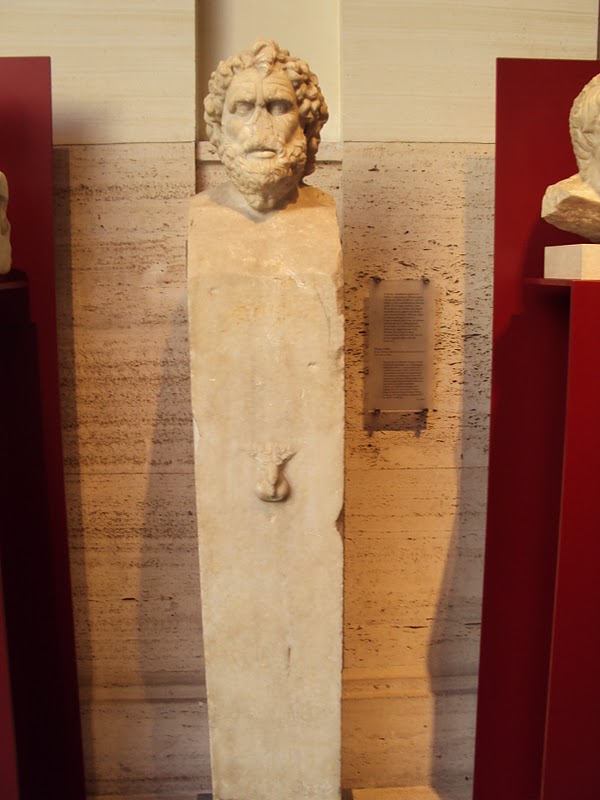

a tombstone

Wednesday, September 28, 2011

Ancient Rome: Where they Lived: Villa, Domus, Insula

One of the more interesting exhibits I have visited this summer here in Rome is the "Once We were Romans" exhibit in the Museo Nationale Romano in the Palazzo Massimo, and the most interesting part, for me, was the display of the excavated remains of the houses (domus) and villas of the wealthy Romans.


There were three types of Roman houses at the time of Augustus Caesar. The first two were the homes of the "elite" , the nobility, the wealthy, the powerful upper class Romans. These were the villa, which were country homes and the domus, usually located in the city. Most of the wealthier Romans, however, owned a domus in the city and a country house or villa.


Then there was the insula, which were rented accomodations, essentially a  combination of modern day  condominiums and tenement housing. Here the “wealthier” tenants lived on the ground or lower floors with larger, cleaner and better appointed accommodations. The less able were housed on the higher floors, the higher one went, the worst the living space became, until one reached the top floor where the living space was barely habitable. Accomodations on the top floor of the Insula were only taken by people who could not afford anything better. These were usually makeshift additions to the building and being on the top floor made it very difficult to escape if a fire ever started in the building. And fires happened with great frequency in ancient Rome! This is in contrast with today's condominiums where the higher one goes, the more expensive the accomodation becomes. 


Ruins of top floors of insula beside the Capitoline
 The most opulent domus in ancient Rome had to be Nero's Domus Aurea or Golden House, whose facade was rumoured to have been coated with gold. Ok, technically this was not really a domus but Nero called it his domus, so a domus it is. Nero's domus was razed to the ground by Vespasian, over which he built the Coliseum. Trajan later built his baths over the rest of the complex and it was pretty much forgotten until recent excavations unearthed intact portions of it, reminders of the magnificence or opulence of the place. Unfortunately, these ruins are closed for restoration at the moment.

Livia’s villa, found in Prima Porte, a suburb of Rome and presently still being excavated, may be more representative of the ancient villas of the nobility than the Golden House. This villa was part of the dowry of Livia Drusilla when she married Octavian, later known as Augustus Caesar.


They discovered a windowless room with painted frescoes of birds, tress, flowers and fruits of the time on all the walls, which they restored and moved into the museum. It is quite beautiful!

I sat in the middle of this room for a long time. The colours were very soothing,  and the rendition of the fruits, flowers and birds were detailed and very naturalistic.


The Domus was smaller than the villas, being limited by the available space in the city. The museum had the remains of Aggrippa's (Augustus' friend and son-in-law) Domus/Villa found in the Trastevere Area.


Excavation Site

Villa floor made of alabaster
 They were usually rectangular in shape divided into two areas, with a garden and a peristyle off to one side and the atrium on the other. It was surrounded by a perimeter wall with a front door sporting a knocker made of bronze.  One enters the domus through the vestibulum or entrance hall which were lined with frescoes and had mosaic floors. Most of the floors were made of marble but some of the more opulent villas had floors made of alabaster.


atrium walls of Agrippa's Domus
 The main part of the house was the atrium where guests and clients were greeted. In the middle of the atrium was a "water feature",  underneath an opening in the roof, which was a shallow sunken pool collecting rain water which was then stored in a cistern for the use of the household. This was lined with marble and around it, a floor of small mosaics. The Atrium contained a statue and an altar to the household god.  Around the atrium would be found the family’s main rooms.

The walls of the cubiculum or bedrooms were filled with brightly coloured frescoes, (some of them with very explicit erotic paintings) and mosaic floors with intricate geometric designs.


Erotic fresco on bedroom wall


cubicula


detail of fresco


bedroom with frescoes and parts of ceiling

The tablinium or office was where the master would meet his clients. This was usually located between the atrium and the peristyle.

The dining room or triclinum was also elaborately painted with frescoes and had mosaic marble floors. These contained coaches around a low table. The colors used in the dinning room were usually darker than those of the other rooms.

There were no kitchens as we know them today. Because food preparation was a task left completely to the slaves, the area where this was done was small, dark, poorly ventilated and relegated to an obscure area of the house.

Most domus had a bathroom, some only in the form of latrines, since most Romans made it a habit to visit the public baths not only for their daily bath but as a place to meet people and do business. Most domus had running water and sewage disposal.

The Romans loved color, they put a lot of that around their temples, their monuments, their buildings. Their homes were the same, brightly colored and containing precious works of art, frescoes, marble inlays and statues and beautiful mosaic floors. They were proud of their homes, using these to mirror their accomplishments and enhance their reputations. But more than this, they treasured them as their place of refuge, their safe haven. 


Thursday, September 22, 2011

Mangiamo, Let's Eat Pasta!

Some people say that pasta was brought by Marco Polo to Italy from China. But Italians will tell you that long before Marco Polo came back to Italy, the Italians were already enjoying pasta in some form or the other. According to an Italian friend, archeological sites have found remnants of some form of pasta from the Etruscan times. According to this same “source” the first kind of pasta “lagare”, made from flour and eggs but baked on hot stones, may well have been the predecessor of the lasagne. Another theory is that the Arabs brought the pasta to Sicily, which may according to my friend be given credence by people who believe like Goethe that "Sicily is the clue to everything". Origins (and other noodle cultures) notwithstanding, pasta; spaghetti, fussilli, penne, fettucini etc. in all its shape and sizes today is as Italian as .....

Pasta in all its form and sauces is served in any of the numerous tavolas, osterias, bars and restaurants galore here in Rome. I have eaten in many of these, just stopping anywhere when hunger pangs strike, which for me come consistently at 12 pm for lunch. I invariably end up ordering a penne al ‘arrabiata or spaghetti con vongole. I have never had a really bad pasta here in Rome but there are places, places I have gone back to which I would consider a cut above the rest.

Spaghetteria L’Archetto


We found this place by accident, as we were exploring the area around the Fountain of Trevi. In one of the side streets coming from the Fountain on Via Archeto, we came upon this restaurant and decided to walk in. And we’ve been going back ever since, and bringing guests from home. Living up to it's name, the menu consists of a thick book of different sauces for ..... spaghetti! They have a rather thick menu with other items but many, many pages are devoted to spaghetti sauces. They have tomato based sauces, cream based sauces, pesto based sauces ragu and meat based sauces and even fish and crustacean based sauces which are available only on Tuesdays and Fridays. They even have spicy sauces, one of which passed the chilli requirements of a Malaysian friend! It is very difficult to choose, but we have managed to try a lot of them since that first time. We’ve had vongole, bacailloli, carbonara, putanesca, arrabiata, wild mushroom and even one called “Nuclear Bomb”, a pesto based sauce with broccoli.


It is a popular restaurant, not only with tourists because of its proximity to the Trevi Fountain but also with locals and sometimes it may take a while before you get served. But we’ve always found the food well worth the wait.


We’ve eaten outside on the street by the restaurant, below a beautiful vine creeping up the wall, and also inside where we had to go down two levels, both filled with tables and customers. And as one goes down those steps, along the wall on the left side is a black and white picture of a very young Sophia Loren.

Ristorante Alfredo


I am including this restaurant in my pasta blog only because this restaurant serves the original fettuccini Alfredo. The dish was invented in 1914 by a restaurateur called Alfredo di Leilo in his restaurant on Via Scroffa which is still there today but is now owned by someone else. According to the story, he invented this dish when his wife was expecting and could not eat anything. It is simply fettuccini with a lot of butter and cheese. The dish became famous when Douglas Fairbanks and Mary Pickford came to eat at the restaurant during their honeymoon. They fell in love with the dish and gave Alfredo a golden spoon in gratitude. Today you see a picture of these two artists on the wall of the restaurant.

Fettuccini Alfredo

The fettuccini is tossed with the cheese at tableside and the maître‘d makes a show of it. We have eaten here twice and we have ordered one order of fetuccini for three or four of us as our primi piatti to share. It is delicious but way too rich! The first time we ate there with my daughter and my husband, I ordered a steak with truffle oil as my main dish and it was good, the second time however, the steak was overcooked and dry.

Friday, September 16, 2011

Basilicas of Rome: Santa Maria Maggiore

Rome is full of treaures, historical ruins, works of art, imposing architecture, engineering marvels etc., some in full view, others displayed in museums both public and private. To get into these museums one needs to fork out a certain amount of euros. There are however repositories of some of these treasures that are open and available to anyone, the only requirement to enter is one be dressed "appropriately". These are the churches in and around Rome. It has been an experience for me going into these churches sometimes for the purpose of hearing mass and then finding myself going around taking pictures after. There has been those times too where I have gone to a specific church to look at say a statue by Micheangelo or a painting by Caravaggio and ended up going to mass as well.

Among the thousands of churches, there are three churches in Rome that have been given extraterritorial status similar to that of foreign embassies. Article 13 of the Lateran Treaty of 1929 between the Holy See and Italy states: "Italy recognizes the full ownership of the Holy See over the patriarchal Basilicas of St. John Lateran, the Sta. Maria Maggiore, and St. Paul Outside the Walls, with their annexed buildings." These buildings are patrolled not by Italian police but by police agents of the Vatican City State. These Basilicas and St Peters are the only four “major” Basilicas in Rome and the Papal Basilica of Saint Mary Major (Basilica di Santa Maria Maggiore) with it's Byzantine interior, one of the best preserved in Rome is the only one dedicated to the Blessed Virgin.

It is said that the Basilica stands on the site of an ancient temple to the goddess Cybele. According to legend the Virgin Mary appeared to Pope Liberius in a dream, asking him to build a church in Her honour on the top of the Esquiline hill, on the spot where he would find a patch of newly fallen snow. The next day, August 5, at the height of the Roman summer, snow had fallen on the spot where Maria Maggiore is now located. At the top of the altar of the Borghese Chapel in the Basilica, the event is immortalized in a bas relief sculpture of Pope Liberius tracing the perimeter of the church in the snow. This event continues to be celebrated every year on the 5th of August. During the noon mass, white rose petals are showered on the congregation from the ceiling and at night the fire department operates a snow making machine in the Piazza in front of the Basilica.


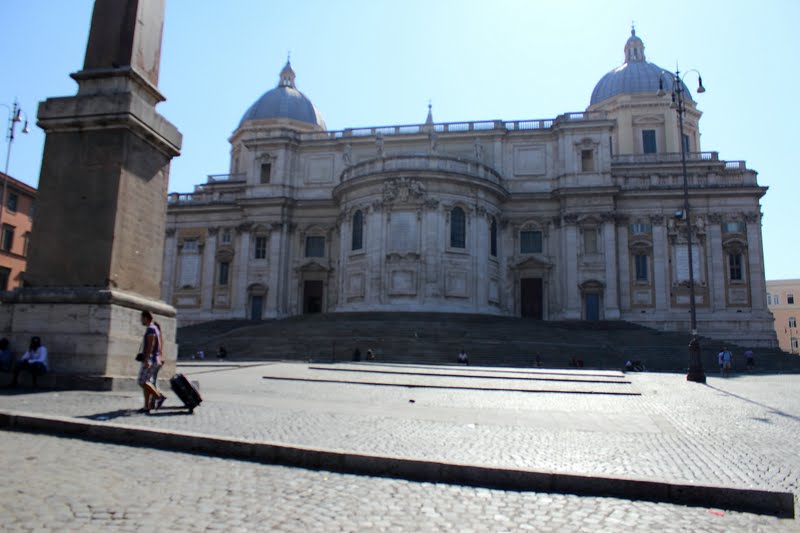
The Basilica when viewed from the Piazza of Santa Maria Maggiore stands behind a column on top of which rests a bronze statue of Mary. The eighteenth century facade has a porch with five openings on the bottom and three on the top which covers the XII century mosaics of the antique facade. Clearly visible from the piazza is also the highest campanile in Rome. On the other hand, viewed from the Piazza Esquilino, one sees the apse area and the domes of the Borghese and Sistine Chapels.


Entering the Basilica, one is immediately struck by the brilliance of the gilded ceiling reportedly with gold sent by Queen Isabella as part payment of a loan extended by then Pope Innocent VIII to finance Christopher Columbus’ voyage to the New World. The gilded ceiling bears the coat of arms of the Borgia pope Alexander VI, (yes that Alexander) who had a hand in the building of the Basilica  while serving as its Archpriest. He undoubtedly had expensive and impeccable taste, this controversial pope, and was responsible for building other noteworthy  structures, as well as the aquisition of art masterpieces during his term in office.The beautiful cosmatesque mosaic floor was made by Cosmati, considered the “master of marble” and from whose family workshop these geometric decorations originated.


The central nave, is lined on both sides with a series of mosaics from the fifth century depicting scenes from the Old Testament. Below these are Athenian marble columns, 40 in all, which may have come from some more ancient structure and made to fit. On top of the mosaics are frescoes and windows.


Right in the middle of the aisle is the ornate canopy, crowned by the triumphal arch, under which only the Pope can say mass.


The mosaics of the triumphal arch depict scenes from the life of Christ. The mosaics are vivid and dazzling!


And crowned by the arch is the mosaic on the apse, completed a bit later than the arch but just as awesome. This mosaic depicts the coronation the Virgin Mary as Queen of Heaven, surrounded by the saints, angels and pope Nicholas IV who commisioned this. Underneath is the nativity painting by Mancini.


Right above the nativity painting and below the apse mosaic is a mosaic depicting the death of Mary.


Salus Populi Romani
 On the left transept is the Borghese chapel with its grand altar made of lapis lazuli, on which is mounted the icon of the Salus Populi Romani, which tradition says was painted by Luke the Evangelist, the frame of which is supported by gilded angels. The entire chapel is made of marble with bronze and stucco angels all over the ceiling and walls, and at the center of the chapel is one of the two domes of the Basilica.

On the right transept is the Sistine Chapel (not to be mistaken for the one in the Vatican) which is undergoing repairs. I was able to take a picture of the altar, which I think is located at the center of the chapel. This chapel has the other dome.


Between these two chapels in the area called the confessio, one sees a giant kneeling statue of Pope Pius IX, one of the longest serving popes, worshipping the reliquary in the altar. The reliquary made of rock crystal and silver is said to contain some wood fragments from the manger on which the Infant Jesus lay. On Christmas morning every year, this reliquary is brought around the Basilica in procession and then displayed on the high altar.

There were a lot more treasure on display at this church, one that struck me was the beautiful wooden cross from the first half of the XV century which is housed in the Chapel of the Holy Cross. On the day I visited, as luck would have it, a group of Benedictine monks were chanting in prayer. It was quite beautiful!


The other statue I liked was the statue of Regina Pacis, commissioned at the end of the First World War. The Virgin has a beautiful but sad face. She carries the Child Jesus and her left arm is raised as if to say “Stop”. This is by far the most proactive statue of Mary that I have seen.

Near the Sistine Chapel, one comes across the tomb of Cardinal Gonsalvo Rodriguez, Cardinal bishop of Albano, a rather elegant tomb topped with a mosaic. This tomb is  said to be the work of Giovanni Cosma, a member of the marble artists Cosmati family.


Outside the Sistine Chapel, and on the steps off to the right side leading to the sanctuary, I came across my greatest discovery, the tomb of the Bernini family, including the great Gian Lorenzo Bernini himself.


It is very simple, not even a tomb, just a stone slab. How ironic that one of the greatest baroque artists, a master of the ornate and the dramatic would choose to be buried in the simplest of tombs. Here was a nice paradox; I am inspired to go treasure hunting again, this time in search of Bernini!


Sunday, September 11, 2011

The Pope and the Friar

One of the best gifts I’ve received from my husband is a Kindle, that amazing contraption that allows you to pretty much bring a whole library with you wherever you go. This is a real blessing for “nomadic” people like us, if only because it limits the number of boxes that need to be packed and shipped homeward or onward. Even before coming to Rome, I already had a lot of books in my kindle that were written about Rome or were set in Rome. The last e-book I downloaded was The Borgias by Alexander Dumas (yes, the author of Three Musketeers).  The Borgias have always fascinated me, the notoriety, the arrogance and the belief that the world was theirs for the taking, gave this highly amoral family a reputation that piqued my curiosity.

I downloaded this book after we returned from a long weekend in Florence where the 15th century conflict that Dumas wrote about, between then Pope Alexander VI Borgia and Savonarola, a Dominican friar was dramatically played out in full public view ending in the execution by fire of Savonarola, condemned for heresy. A small plaque marks the exact spot in the Piazza Signoria (Florence’s most elegant Piazza) where the execution took place.


hardly noticed by people walking all over it

Pope Alexander was born Roderic Lancol i Borja in Jan. 1, 1431. He was born in Xativa, Valencia, which at that time was part of Aragon in present day Spain. He adopted his mother’s family name after his uncle; Alonso de Borja was elected pope and became known as Calixtus III. Roderico studied Law in Bologna, but with the ascent of his uncle to the papacy, he was ordained deacon and made Cardinal Deacon at the age of twenty five. Nepotistic appointments saw him ordained a priest in 1468, consecrated a bishop in 1471 and appointed Cardinal as the Bishop of Albano.


from wikipedia

On the death of Pope Innocent VIII, Borja was one of three candidates for the papacy and eventually secured it by engaging in widespread simony. It was rumored that cartloads of gold and precious objects were seen being driven to some cardinal's palaces prior to the election.

When he was elected pope he already had children with his long time mistress; Vanozza dei Catani. He not only acknowledged them but was inordinately fond of them and used the resources of the papacy to advance and enrich all of them. They were Giovanni, made Duke of Gandia (reportedly murdered by Cesare), Cesare, Machiavelli’s Prince, the most infamous of his children and the strong arm and ruthless implementer of Alexander's political machinations, Lucrezia, whom he married off three times using her to secure alliances and who as the Duchess of Farrarra became known for her patronage of the arts as well as her piety. He reputedly had other children, but the parentage of these is uncertain. When he was elected pope, his ardor for Vanozza had waned and he had taken on a new mistress, Guilia Farnese who lived with his daughter, Lucrezia in one of the papal households. Alexander ruled like a secular prince of the time, notwithstanding his position as head of the Catholic Church.


from Wikipedia

On the other hand, Giralamo Francesco Savonarola was of noble birth, his family being one of the more illustrious families in Padua. He was born in Ferrara but at the age of twenty three fled from his father’s home and took the vows in the cloisters of the Dominican monks. The Dominicans, one of two mendicant orders at the time (the other being the Franciscans), were founded primarily to teach the gospel and combat heresy and were called Friar Preachers. The members were encouraged to develop “mixed” spirituality, being active in both preaching and contemplative study, prayer and meditation. Members of this order were urbane and learned men and Savonarola was to become one of its more passionate members. He became very influential and well respected in Florence early in his ministry and was reputedly feared even by the great Lorenzo D’Medici.

Florence at the time of Lorenzo the Magnificent was at the height of its economic and political power. Political and economic wealth led to the pursuit of, and appreciation of more secular concerns. Art and literature flourished and interest in the pursuit of beauty and worldly pleasures did not appear incongruous with the ascetic requirements of Christian doctrine. Into this environment came Savonarola in 1489. Everything going on in Florence (and in Rome) was in complete disagreement with Savonarola’s concept of spirituality and morality.

Savonarola, was a demagogue par excellance, and his sermons started to take effect, leading up to the point where he was beginning to acquire political power. He and his followers with the participation of some of the leading  citizens held Bonfires of the Vanities, where books, immoral art, mirrors, and other material considered decadent were burned in the Piazza della Signoria.

Savonarola preached vehemently against the moral corruption of the clergy at the time, inevitably bringing him into direct conflict with Pope Alexander. Savonarola's fanaticism inevitably led to a defection of many of his followers and in 1497 he was excommunicated by Pope Alexander and then arrested and charged with heresy, sedition and other offences. Under torture, he confessed (but recanted these confessions) to the "crimes" and was sentenced to death. He was burned at the stake in 1498 at the exact same spot where he used to conduct his Bonfires of the Vanities. It was said that his ashes were then thrown into the River Arno.


Piazza della Signoria where Savonarola was burned at the stake
  As for Pope Alexander, after an 11 year reign characterized by corruption, family aggrandizement, selling of church positions and rumors of poisoning and murder carried on by his son Casare with or without his knowledge, he passed away from either malaria or unintentional poisoning (by Cesare) on Aug. 18, 1503. Stories abound that the state of corruption of the body was so bad, leading to speculation that he was poisoned. But it was more likely malaria that killed him as it was prevalent in Rome at the time. As for the state of corruption of the body, this may be attributed to the delay of burial until after the election of a successor at the height of the sweltering heat of the Roman summer. At the time of his death, Alexnder VI was so unpopular that the priests of St. Peter's refused to accept the body until ordered to by the papal staff. It is said that only four prelates attended his funeral and his successor Pius III forbade the saying of prayers for him. His remains were removed from St. Peters and interred in the Church of Sta. Maria in Monserrato, the Spanish national church in Rome.


Borgia's Tomb