Favorite Photos

Favorite Photos
Bernini's Ecstasy of St. Teresa

Thursday, September 22, 2011

Mangiamo, Let's Eat Pasta!

Some people say that pasta was brought by Marco Polo to Italy from China. But Italians will tell you that long before Marco Polo came back to Italy, the Italians were already enjoying pasta in some form or the other. According to an Italian friend, archeological sites have found remnants of some form of pasta from the Etruscan times. According to this same “source” the first kind of pasta “lagare”, made from flour and eggs but baked on hot stones, may well have been the predecessor of the lasagne. Another theory is that the Arabs brought the pasta to Sicily, which may according to my friend be given credence by people who believe like Goethe that "Sicily is the clue to everything". Origins (and other noodle cultures) notwithstanding, pasta; spaghetti, fussilli, penne, fettucini etc. in all its shape and sizes today is as Italian as .....

Pasta in all its form and sauces is served in any of the numerous tavolas, osterias, bars and restaurants galore here in Rome. I have eaten in many of these, just stopping anywhere when hunger pangs strike, which for me come consistently at 12 pm for lunch. I invariably end up ordering a penne al ‘arrabiata or spaghetti con vongole. I have never had a really bad pasta here in Rome but there are places, places I have gone back to which I would consider a cut above the rest.

Spaghetteria L’Archetto


We found this place by accident, as we were exploring the area around the Fountain of Trevi. In one of the side streets coming from the Fountain on Via Archeto, we came upon this restaurant and decided to walk in. And we’ve been going back ever since, and bringing guests from home. Living up to it's name, the menu consists of a thick book of different sauces for ..... spaghetti! They have a rather thick menu with other items but many, many pages are devoted to spaghetti sauces. They have tomato based sauces, cream based sauces, pesto based sauces ragu and meat based sauces and even fish and crustacean based sauces which are available only on Tuesdays and Fridays. They even have spicy sauces, one of which passed the chilli requirements of a Malaysian friend! It is very difficult to choose, but we have managed to try a lot of them since that first time. We’ve had vongole, bacailloli, carbonara, putanesca, arrabiata, wild mushroom and even one called “Nuclear Bomb”, a pesto based sauce with broccoli.


It is a popular restaurant, not only with tourists because of its proximity to the Trevi Fountain but also with locals and sometimes it may take a while before you get served. But we’ve always found the food well worth the wait.


We’ve eaten outside on the street by the restaurant, below a beautiful vine creeping up the wall, and also inside where we had to go down two levels, both filled with tables and customers. And as one goes down those steps, along the wall on the left side is a black and white picture of a very young Sophia Loren.

Ristorante Alfredo


I am including this restaurant in my pasta blog only because this restaurant serves the original fettuccini Alfredo. The dish was invented in 1914 by a restaurateur called Alfredo di Leilo in his restaurant on Via Scroffa which is still there today but is now owned by someone else. According to the story, he invented this dish when his wife was expecting and could not eat anything. It is simply fettuccini with a lot of butter and cheese. The dish became famous when Douglas Fairbanks and Mary Pickford came to eat at the restaurant during their honeymoon. They fell in love with the dish and gave Alfredo a golden spoon in gratitude. Today you see a picture of these two artists on the wall of the restaurant.

Fettuccini Alfredo

The fettuccini is tossed with the cheese at tableside and the maĆ®tre‘d makes a show of it. We have eaten here twice and we have ordered one order of fetuccini for three or four of us as our primi piatti to share. It is delicious but way too rich! The first time we ate there with my daughter and my husband, I ordered a steak with truffle oil as my main dish and it was good, the second time however, the steak was overcooked and dry.

Friday, September 16, 2011

Basilicas of Rome: Santa Maria Maggiore

Rome is full of treaures, historical ruins, works of art, imposing architecture, engineering marvels etc., some in full view, others displayed in museums both public and private. To get into these museums one needs to fork out a certain amount of euros. There are however repositories of some of these treasures that are open and available to anyone, the only requirement to enter is one be dressed "appropriately". These are the churches in and around Rome. It has been an experience for me going into these churches sometimes for the purpose of hearing mass and then finding myself going around taking pictures after. There has been those times too where I have gone to a specific church to look at say a statue by Micheangelo or a painting by Caravaggio and ended up going to mass as well.

Among the thousands of churches, there are three churches in Rome that have been given extraterritorial status similar to that of foreign embassies. Article 13 of the Lateran Treaty of 1929 between the Holy See and Italy states: "Italy recognizes the full ownership of the Holy See over the patriarchal Basilicas of St. John Lateran, the Sta. Maria Maggiore, and St. Paul Outside the Walls, with their annexed buildings." These buildings are patrolled not by Italian police but by police agents of the Vatican City State. These Basilicas and St Peters are the only four “major” Basilicas in Rome and the Papal Basilica of Saint Mary Major (Basilica di Santa Maria Maggiore) with it's Byzantine interior, one of the best preserved in Rome is the only one dedicated to the Blessed Virgin.

It is said that the Basilica stands on the site of an ancient temple to the goddess Cybele. According to legend the Virgin Mary appeared to Pope Liberius in a dream, asking him to build a church in Her honour on the top of the Esquiline hill, on the spot where he would find a patch of newly fallen snow. The next day, August 5, at the height of the Roman summer, snow had fallen on the spot where Maria Maggiore is now located. At the top of the altar of the Borghese Chapel in the Basilica, the event is immortalized in a bas relief sculpture of Pope Liberius tracing the perimeter of the church in the snow. This event continues to be celebrated every year on the 5th of August. During the noon mass, white rose petals are showered on the congregation from the ceiling and at night the fire department operates a snow making machine in the Piazza in front of the Basilica.


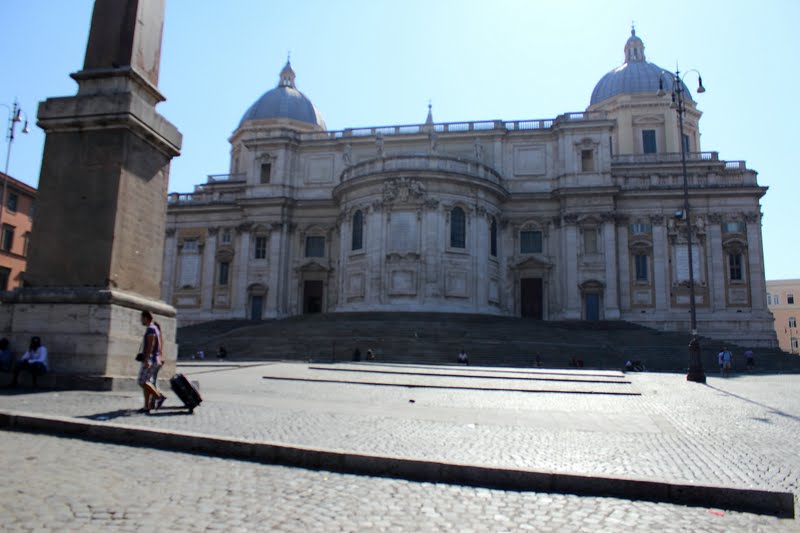
The Basilica when viewed from the Piazza of Santa Maria Maggiore stands behind a column on top of which rests a bronze statue of Mary. The eighteenth century facade has a porch with five openings on the bottom and three on the top which covers the XII century mosaics of the antique facade. Clearly visible from the piazza is also the highest campanile in Rome. On the other hand, viewed from the Piazza Esquilino, one sees the apse area and the domes of the Borghese and Sistine Chapels.


Entering the Basilica, one is immediately struck by the brilliance of the gilded ceiling reportedly with gold sent by Queen Isabella as part payment of a loan extended by then Pope Innocent VIII to finance Christopher Columbus’ voyage to the New World. The gilded ceiling bears the coat of arms of the Borgia pope Alexander VI, (yes that Alexander) who had a hand in the building of the Basilica  while serving as its Archpriest. He undoubtedly had expensive and impeccable taste, this controversial pope, and was responsible for building other noteworthy  structures, as well as the aquisition of art masterpieces during his term in office.The beautiful cosmatesque mosaic floor was made by Cosmati, considered the “master of marble” and from whose family workshop these geometric decorations originated.


The central nave, is lined on both sides with a series of mosaics from the fifth century depicting scenes from the Old Testament. Below these are Athenian marble columns, 40 in all, which may have come from some more ancient structure and made to fit. On top of the mosaics are frescoes and windows.


Right in the middle of the aisle is the ornate canopy, crowned by the triumphal arch, under which only the Pope can say mass.


The mosaics of the triumphal arch depict scenes from the life of Christ. The mosaics are vivid and dazzling!


And crowned by the arch is the mosaic on the apse, completed a bit later than the arch but just as awesome. This mosaic depicts the coronation the Virgin Mary as Queen of Heaven, surrounded by the saints, angels and pope Nicholas IV who commisioned this. Underneath is the nativity painting by Mancini.


Right above the nativity painting and below the apse mosaic is a mosaic depicting the death of Mary.


Salus Populi Romani
 On the left transept is the Borghese chapel with its grand altar made of lapis lazuli, on which is mounted the icon of the Salus Populi Romani, which tradition says was painted by Luke the Evangelist, the frame of which is supported by gilded angels. The entire chapel is made of marble with bronze and stucco angels all over the ceiling and walls, and at the center of the chapel is one of the two domes of the Basilica.

On the right transept is the Sistine Chapel (not to be mistaken for the one in the Vatican) which is undergoing repairs. I was able to take a picture of the altar, which I think is located at the center of the chapel. This chapel has the other dome.


Between these two chapels in the area called the confessio, one sees a giant kneeling statue of Pope Pius IX, one of the longest serving popes, worshipping the reliquary in the altar. The reliquary made of rock crystal and silver is said to contain some wood fragments from the manger on which the Infant Jesus lay. On Christmas morning every year, this reliquary is brought around the Basilica in procession and then displayed on the high altar.

There were a lot more treasure on display at this church, one that struck me was the beautiful wooden cross from the first half of the XV century which is housed in the Chapel of the Holy Cross. On the day I visited, as luck would have it, a group of Benedictine monks were chanting in prayer. It was quite beautiful!


The other statue I liked was the statue of Regina Pacis, commissioned at the end of the First World War. The Virgin has a beautiful but sad face. She carries the Child Jesus and her left arm is raised as if to say “Stop”. This is by far the most proactive statue of Mary that I have seen.

Near the Sistine Chapel, one comes across the tomb of Cardinal Gonsalvo Rodriguez, Cardinal bishop of Albano, a rather elegant tomb topped with a mosaic. This tomb is  said to be the work of Giovanni Cosma, a member of the marble artists Cosmati family.


Outside the Sistine Chapel, and on the steps off to the right side leading to the sanctuary, I came across my greatest discovery, the tomb of the Bernini family, including the great Gian Lorenzo Bernini himself.


It is very simple, not even a tomb, just a stone slab. How ironic that one of the greatest baroque artists, a master of the ornate and the dramatic would choose to be buried in the simplest of tombs. Here was a nice paradox; I am inspired to go treasure hunting again, this time in search of Bernini!


Sunday, September 11, 2011

The Pope and the Friar

One of the best gifts I’ve received from my husband is a Kindle, that amazing contraption that allows you to pretty much bring a whole library with you wherever you go. This is a real blessing for “nomadic” people like us, if only because it limits the number of boxes that need to be packed and shipped homeward or onward. Even before coming to Rome, I already had a lot of books in my kindle that were written about Rome or were set in Rome. The last e-book I downloaded was The Borgias by Alexander Dumas (yes, the author of Three Musketeers).  The Borgias have always fascinated me, the notoriety, the arrogance and the belief that the world was theirs for the taking, gave this highly amoral family a reputation that piqued my curiosity.

I downloaded this book after we returned from a long weekend in Florence where the 15th century conflict that Dumas wrote about, between then Pope Alexander VI Borgia and Savonarola, a Dominican friar was dramatically played out in full public view ending in the execution by fire of Savonarola, condemned for heresy. A small plaque marks the exact spot in the Piazza Signoria (Florence’s most elegant Piazza) where the execution took place.


hardly noticed by people walking all over it

Pope Alexander was born Roderic Lancol i Borja in Jan. 1, 1431. He was born in Xativa, Valencia, which at that time was part of Aragon in present day Spain. He adopted his mother’s family name after his uncle; Alonso de Borja was elected pope and became known as Calixtus III. Roderico studied Law in Bologna, but with the ascent of his uncle to the papacy, he was ordained deacon and made Cardinal Deacon at the age of twenty five. Nepotistic appointments saw him ordained a priest in 1468, consecrated a bishop in 1471 and appointed Cardinal as the Bishop of Albano.


from wikipedia

On the death of Pope Innocent VIII, Borja was one of three candidates for the papacy and eventually secured it by engaging in widespread simony. It was rumored that cartloads of gold and precious objects were seen being driven to some cardinal's palaces prior to the election.

When he was elected pope he already had children with his long time mistress; Vanozza dei Catani. He not only acknowledged them but was inordinately fond of them and used the resources of the papacy to advance and enrich all of them. They were Giovanni, made Duke of Gandia (reportedly murdered by Cesare), Cesare, Machiavelli’s Prince, the most infamous of his children and the strong arm and ruthless implementer of Alexander's political machinations, Lucrezia, whom he married off three times using her to secure alliances and who as the Duchess of Farrarra became known for her patronage of the arts as well as her piety. He reputedly had other children, but the parentage of these is uncertain. When he was elected pope, his ardor for Vanozza had waned and he had taken on a new mistress, Guilia Farnese who lived with his daughter, Lucrezia in one of the papal households. Alexander ruled like a secular prince of the time, notwithstanding his position as head of the Catholic Church.


from Wikipedia

On the other hand, Giralamo Francesco Savonarola was of noble birth, his family being one of the more illustrious families in Padua. He was born in Ferrara but at the age of twenty three fled from his father’s home and took the vows in the cloisters of the Dominican monks. The Dominicans, one of two mendicant orders at the time (the other being the Franciscans), were founded primarily to teach the gospel and combat heresy and were called Friar Preachers. The members were encouraged to develop “mixed” spirituality, being active in both preaching and contemplative study, prayer and meditation. Members of this order were urbane and learned men and Savonarola was to become one of its more passionate members. He became very influential and well respected in Florence early in his ministry and was reputedly feared even by the great Lorenzo D’Medici.

Florence at the time of Lorenzo the Magnificent was at the height of its economic and political power. Political and economic wealth led to the pursuit of, and appreciation of more secular concerns. Art and literature flourished and interest in the pursuit of beauty and worldly pleasures did not appear incongruous with the ascetic requirements of Christian doctrine. Into this environment came Savonarola in 1489. Everything going on in Florence (and in Rome) was in complete disagreement with Savonarola’s concept of spirituality and morality.

Savonarola, was a demagogue par excellance, and his sermons started to take effect, leading up to the point where he was beginning to acquire political power. He and his followers with the participation of some of the leading  citizens held Bonfires of the Vanities, where books, immoral art, mirrors, and other material considered decadent were burned in the Piazza della Signoria.

Savonarola preached vehemently against the moral corruption of the clergy at the time, inevitably bringing him into direct conflict with Pope Alexander. Savonarola's fanaticism inevitably led to a defection of many of his followers and in 1497 he was excommunicated by Pope Alexander and then arrested and charged with heresy, sedition and other offences. Under torture, he confessed (but recanted these confessions) to the "crimes" and was sentenced to death. He was burned at the stake in 1498 at the exact same spot where he used to conduct his Bonfires of the Vanities. It was said that his ashes were then thrown into the River Arno.


Piazza della Signoria where Savonarola was burned at the stake
  As for Pope Alexander, after an 11 year reign characterized by corruption, family aggrandizement, selling of church positions and rumors of poisoning and murder carried on by his son Casare with or without his knowledge, he passed away from either malaria or unintentional poisoning (by Cesare) on Aug. 18, 1503. Stories abound that the state of corruption of the body was so bad, leading to speculation that he was poisoned. But it was more likely malaria that killed him as it was prevalent in Rome at the time. As for the state of corruption of the body, this may be attributed to the delay of burial until after the election of a successor at the height of the sweltering heat of the Roman summer. At the time of his death, Alexnder VI was so unpopular that the priests of St. Peter's refused to accept the body until ordered to by the papal staff. It is said that only four prelates attended his funeral and his successor Pius III forbade the saying of prayers for him. His remains were removed from St. Peters and interred in the Church of Sta. Maria in Monserrato, the Spanish national church in Rome.


Borgia's Tomb


Monday, September 5, 2011

The Palatine, the Aventine and Circo Massimo

Rome was not built on 7 hills, (I’m not being facetious here), its foundations were built on the Palatine Hill and its boundaries later expanded to include all those 7 hills.  Legend attributes the founding of Rome to an augury contest between Romulus, who wanted to build Rome on the Palatine Hill and Remus, who favoured the Aventine Hill. Given a designated time frame, the twins spotted and counted the number of aves or auspicious bird that flew over the hills, with Romulus seeing one more bird fly over the Palatine. This decided the contest.


Rome's founders
In my attempt to discover ancient Rome, I have found that walking is the best way to go, not only because one gets an understanding of the distances involved but also ensuring that one does not miss anything (Rome after all is an open air museum!) I have walked the Forum, where the Romans worked and carried on the business of government, the Capitoline hill where they worshipped among other things, and the Palatine and the Aventine hills, where they lived. In addition, I have also explored the site of the Subura where the "poorer" Romans and foreigners lived and worked.


Remains of Augustus' Palace

The patricians, the senators and the emperors lived on the Palatine. While the rich plebeians, merchants and military men lived on the Aventine, with a lot of them aspiring to buy up and someday live on the Palatine.


Remains of the Circo Massimo

 In the valley between these two areas, I have also walked the Circo Massimo, an enormous open area, where entertainment in the form of chariot races, battle re-enactments, and animal hunts were staged.  


Ruins of Nero's palace

At present, the Palatine, the site of the imperial residences of ancient Rome lies mostly in ruins and yet the place is beautiful, a wonderful mix of historical ruins, tall, stately cypress trees looking like huge shady umbrellas, luxuriant flowering shrubs and rich patches of green grass, inviting one to sit back and take a break.

Foundations Romulus Hut


Time can be forgotten as one walks through the Palatine, seeing Augustus’ palace connected to Livia’s by a tunnel, Nero’s Cryptoportico, Romulus’ hut, the temple of the Cybeles and then tucked away in a corner, a clump of beautiful blue flowers.


On the northern side of the Palatine lie the ruins of the Horti Farnesiana, a summer residence with magnificent gardens built by Cardinal Allesandro Farnese. These ruins are perched right over the Forum.


The Aventine on the other hand appears to have functioned as the entry point for foreigners and foreign cults. It may have been public land and as time went on, the plebes were granted property rights there. The Aventine eventually became the area where the plebeian aediles, tribunes and “plebeian nobility” lived. The hill today is one of the most elegant, more expensive residential areas in the city.


a house on the aventine hill

I started my walk up the Aventine from the metro station named after the Circo Massimo, crossing the street and walking up the Via Circo Massimo where one can see the whole length of the Circo crowned with the ruins of the Palatine, to my mind one of Rome’s most impressive sights!


Events at the Circo

Walking up the hill, passing the rose garden on the Via de Valle Murcia, the noise of the traffic slowly recedes, as one passes through leafy streets and walled gardens.


At the top of the hill is the Parco Savello, a peaceful, public park with tall trees providing a shady canopy and a grove of orange trees which gives the whole area a wonderful subtle, sweet fragrance.


An imposing water fountain is at the entrance and the church of Santa Sabina, one of the more popular wedding venues, is at the left side of the park.


At the summit is the Priory of the Knights of Malta, a secretive chivalric order founded in 1050. The Priory grounds are reportedly very beautiful, but unfortunately are close to the public. What draws tourists to this place is the Priory’s keyhole, through which one sees the far away dome of St. Peter’s Basilica. Across the Priory, is the Church of San Anselmo, a Benedictine complex with a pleasant garden and a shop that sells products made by the monks like jams (the wild cherry jam is very good!), grappa, creams, and soaps among other things.

Before going back down, I decided to return to the Parco Savello, where I did as the other people were doing, just sitting around and relaxing, and enjoying the view! 

Wednesday, August 31, 2011

Iconic Structures of Rome: The Fountain of Trevi

“Three coins in a fountain”.... a song that made many a young girl of my generation visiting Rome, fantasize about meeting someone as romantic as Rossano Brazi and having that perfect Roman holiday! For my mom it was Felinni's La Dolce Vita, with my teenage niece on the other hand, the movie was the Lizzie McGuire Movie with Hilary Duff. So the world moves on, movies and movie stars fade and new ones take their place but the Trevi Fountain remains what it has been, and may be for a long time to come, an iconic symbol of Rome.
Walking along the Via Corso, there are signs that point you to the more visited spots in Rome. One of these, closest to Piazza Venezia is the sign pointing to the Trevi Fountain. Following this sign in the straightest way possible in the twisting, narrow streets of Rome brought us to Via Stamperia where the sounds of water became more and more audible, letting us know that we were indeed approaching the Fountain. Following the sounds, we turned a corner and almost suddenly it’s there right in front of you...the Trevi Fountain!


The Piazza
The Piazza della Fontana Trevi is a rather small piazza and the Fountain itself is not in the center of the piazza but is actually built into the back of the Pallazo Polli. Because of its size, the number of people you encounter milling around the piazza can be quite overwhelming!


Ocean personified
The Trevi Fountain, the largest baroque fountain in Rome stands at the juncture of 3 waterways, the Aqua Virgine, the Aqua Virgo and one of the repaired ancient aqueducts, hence the name Trevi. The aqua Virgo was constructed by Marcus Vispanius Agrippa, Augustus Caesar's friend and ablest general and also the person who first built a structure on the spot where the Pantheon is today, still carrying his name on it's facade. In the 15th century a simple fountain was erected in this spot to mark the endpoint of the aqueduct as was the practice at the time. In the 17th century Pope Urban VIII asked Gian Lorenzo Bernini to make improvements on the fountain but the project was put on hold due to lack of funds.


Calm Waters
Actual work on this fountain only started in 1732 after Nicolo Salvi won a competition held by Pope Clement II to design the fountain. The funds for the building came from the third drawing of the Lotto game (yes the lotto!) in May 1732. It took Salvi almost 30 years to complete the project and he died in the process, his lungs completely damaged because of the time spent in the dank waterworks of the fountain.


Raging Waters
The fountain is 85.28 feet hight, 160.72 feet wide and spills 80,000 cubic meters of water a day. The facade is made of travetine blocks (from Tivoli) and the statues are of carrara marble. The main statue is a depiction of Ocean riding a shell chariot pulled by two sea horses. One of the horses is calm, the other, restless, signifying the fluctuating moods of the sea, with the water in the fountain representing the sea.


Bring us back to Rome
According to some, the custom of throwing coins in the fountain goes back to an ancient Roman tradition of throwing a coin into fountains, rivers and lakes at the start of a journey to ask the gods to favor the journey and to bring them back safely. However, the more cynical explanation is that someone in the city invented the tradition in order to raise funds for the maintenance of the fountain. Which was a brilliant plan as Wikipedia says around 30,000 euros (some italians don't believe this, saying that a lot of tourists toss in the "little" coin) a day is collected from the fountain!
We slowly made our way forward until we managed to squeeze in right to the front of the fountain, where we tossed the obligatory coins with our backs turned to the fountain. They say three coins held in the left hand and tossed over the right shoulder....or was it the other way around? Whichever way, We embraced the legend (after all this was not our first time to do this) and chose to believe that those coins will bring us back to Rome once again. And by the way, we contributed 3 euros to the total collection for the day!