Favorite Photos

Favorite Photos
Bernini's Ecstasy of St. Teresa

Wednesday, August 17, 2011

Ancient Rome: The Roman Forum


I have been to the Roman Forum three times now but have had difficulty starting a blog about it. It became a difficult task I think because stepping into the Forum leaves one with so much to think about, but on the other hand there is disappointingly very little to see. It is difficult to reconstruct what was once there and more difficult to disregard the “mutilation” that is there. One cannot help but lament the result of years of “plunder” by popes and rulers that have left this place resembling the  emperor of the childrens' classic story, parading without a stitch of clothing, or...ok...just in his underwear!


The forum taken from the Tabularium


foundation of Romulus'Hut
Having said that, stepping into the Forum aroused echoes of school, memories of oratorical moments, and recapturing history and literature lectures of exceptional quality, rekindling for me once again interest and awe in all things Roman. There is something about  it (the Forum) that captures the imagination, standing on the spot where Romulus lived, walking down the same path that Cicero, Brutus, Marc Anthony et. al. trod on, and standing on the spot where Julius Caesar’s remains were entrusted to the heavens.   And so I stayed and came back again and again, going through the ruins and trying to see in my mind’s eye the way it was before.


The Forum is a rectangular plaza which began its existence as a marketplace. For centuries it was the center of Roman public life, the site of elections, triumphal parades, gladiatorial matches (before the coliseum was built), public trials, venue for speeches and rallies, in short “the teeming heart of ancient Rome”.

One enters the forum through the Via Sacra. Walking north toward the Capitoline Hill, one comes upon the Temple of Romulus on the right. It is a round temple still possessing its bronze doors, built by Maxentius, an opponent of Constantine in memory of his son Romulus. Behind this, Emperor Nerva built his Forum Pacis which was transformed in the middle ages, to the church of Saints Cosme and Damiano, thus saving it from destruction and "looting". 


In front of this temple was the site of the home of the Vestal Virgins, whose duty it was to tend the holy fire in the Temple of Vesta. Vesta was the goddess of the hearth fire, the center of the roman house and worshipped in the family circle. The temple guarded the “holy fire”, the symbol of the life of the city, and as such could not be allowed to die down. Every year, during spring cleaning time, embers from the old fire would be kept in order to re-kindle the fire anew.

This fire was tended by 6 Vestal Virgins. The Vestals were very important women, in that performance of their one and only task was tied to the continuity of the Roman state. This duty was considered of the utmost importance and so young girls from the most notable families were chosen from a very young age to become vestals. They were brought into service at the age of 6 to 10 years of age, underwent a 10 year training period and served for 30 years. They took a vow of chastity which had to be adhered to until the term of service ended. Some of them never left the temple, choosing to live out their lives as vestals, some left the temple and even married and had children. However, if a vestal broke this vow of chastity while still a vestal, the punishment was “entombment”, being buried alive.

All that remains of the House of the Vestals is  the rectangular courtyard with a tiny pool in the middle and statues of past Vestale Maximates (head vestals) around it. To the sides are remains of the rooms which these women stayed in. Apparently some of them are very well preserved unfortunately, they are not opened to the public. This area has a nice, tranquil feel about it, grass covered the courtyard around the square pool and creepers and flowers dotted the walls and the garden. In front of the House of the Vestals is the Temple of Vesta, a white circular structure. 

Just in front of the House of the Vestal Virgins to the right lie the remains of the Regia. This is one of the oldest structures in the Forum, said to be built by Numa one of the first kings. This was the residence of the kings and then became the lodging place of the Pontifex Maximus, the highest priest in the board of Pontifices tasked among other important duties, with making the calendar, namely designating dates when events, celebrations and other important aspects of daily life could take place.


In front of the Regia, one sees what remains of the Temple of Caesar, built by Augustus to honor the deified Julius Caesar. The temple was built on top of the spot where his remains were cremated after his assassination, which occurred not at the Curia in the Forum, as is commonly thought, but at the Curia in the Theatre of Pompey. Today only the foundations are visible, and these are covered by a small wooden structure topped by GI sheets. Inside, some people still leave flowers and other tributes on the mound, and tour guides recite in sonorous voices Shakespeare’s, “I’ve come to bury Caesar, not to praise him!”

Just beside the Temple of Romulus is the Temple of Antoninus and Faustina, which was built by Antoninus in memory of his wife Faustina. This was later (7th or 8th century AD) converted into a church and as such avoided the destruction suffered by other buildings around it. Today it is known as the Church of San Lorenzo in Miranda.

Beside the House of the Vestal Virgins are found three columns, all that remains of the Temple of Castor and Pollux, built in 484 BC and used not only as a temple but for military ceremonies, senate rituals and also a place where many plans and initiatives were discussed or undertaken.

Fronting the Temple of Castor and Pollux are the ruins of the Basilica of Aemilia built in 179 BC, which consisted  of 2 levels. In the 5th century, as the legend goes, in this place, Lucius Verginius stabbed his daughter to death to prevent her from becoming a slave of Appius Claudius who desiring her, had by nefarious means, while her father was away at war, managed to have her declared his slave. This same Appius Claudius was one of the forbears (and the skeleton in the closet) of the Claudii, one of ancient Romes's most powerful families.

Near the Temple of Castor lie the ruins of the Basilica Julia, (the rectangular area seen here  behind  the arch of Septimus Severus) started by Julius Caesar and finished by Augustus Caesar. This functioned as a court where civil cases (centumviri) were heard. There were 45 chambers and the public was allowed to attend these sessions. Lawyers on both sides encouraged partisans to attend these sessions in the hopes of influencing the outcome by their vociferous support. You can imagine how raucous some of the sessions became. This burnt down in the 9th century AD.


Near the Basilica Aemilia is the Curia Julia (the rectangular building) which goes back to 300 AD. This is the final form taken by the Curia which had been built and burned four times in its history. Caesar began building this and it was completed by Augustus. This was where the senators met. Two hundred senators at a time could be accommodated in the curia, seating on rows of seats along the long side of the Curia (today busts and statues are exhibited along this wall). The building still stands, but its huge bronze door now serves as the front door of the Cathedral St. John Lateran.

Beside the Curia is the Tullianum or the Mamertime prison which has two floors. The upper floor was where prisoners were kept and the lower floor was where they were executed. Enemies of Rome like Jugurtha from Africa, Vercingetorix from Gaul, the Gracchi brothers and the accomplices of Catilina were imprisoned and executed here. Two other prisoners of note were St. Peter and St. Paul. This is the main reason why the Church of St. Peter in Prison (on the right) was built over this jail. You can still go into this notorious place for the price of 5 Euros.

Toward the southernmost part of the Forum stands the Arch of Septimus Severus (behind the columns of Castor and Pollux) which was to commemorate this emperor’s triumphs in the east. He was father to Caracalla, a cruel ruler who in turn built the famous baths of Caracalla.

North of the Basilica Julia is the Temple of Saturn, one of the most respected monuments in ancient Rome and the place where the Saturnalia was held, a celebration of great importance to honor Saturn Cronos, the youngest of the Titans and the father of Jupiter, Rome's primary god. This was a week long celebration where schools were called off, presents exchanged and gambling was allowed even to the slaves. Today all that’s left of this temple are some columns.

The Temple of Concordia is found on the top of the forum. This was inaugurated in 366 BC as a symbol of reconciliation between the plebes and the patricians following a law passed guaranteeing that one of the 2 consuls would be from the ranks of the plebes. There is hardly anything left of this today.

Beside the Temple of Concordia are the ruins of the Temple of Vespacian (seen here from the Tabularium). This was built by Domitian to honor his father and his brother Titus.

Behind the Temple of Concordia is the Tabullarium, which contained the Roman public records office. On top of this was the aerarium or treasure house of the Temple of Saturn. Today this is part of the Capitoline Museum, opened to the public and one can take a picture of the entire ancient site from its windows.


It is tiring to walk the ruins of the Forum especially in the heat of the summer. However, even for someone with very high expectations of the place like myself, and despite the initial dissapointment, doing it is rewarding. As I walked away from the Forum (the third time) in the direction of the Palatine Hill, I realized I had fallen victim to the magic of the place. The hours had passed unnoticed and I needed sometime to reorient myself to the present.

Thursday, August 11, 2011

Churches: Sainte-Chapelle in Paris

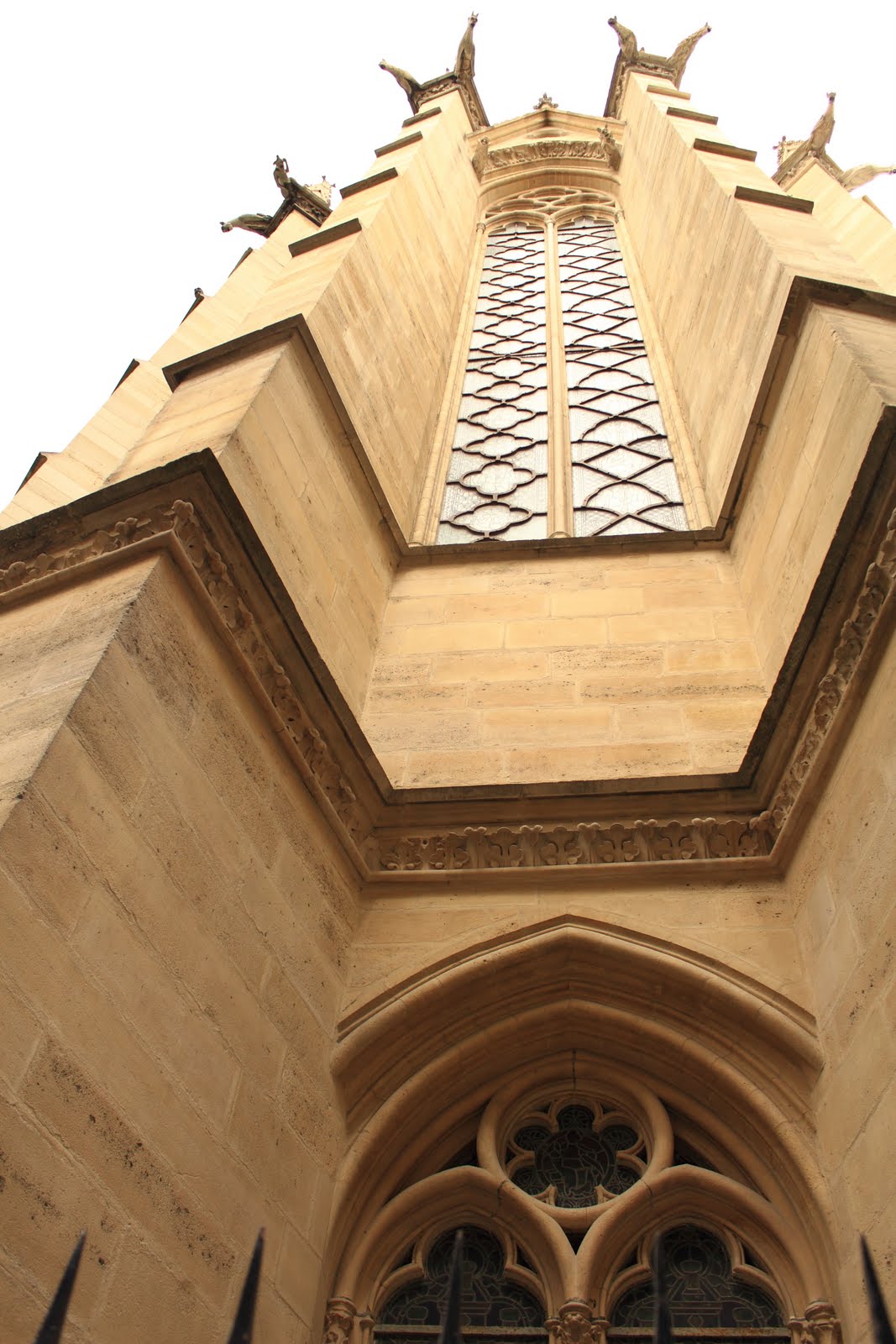
I wanted to go into the Notre Dame Cathedral during our weekend in Paris but was unable to. But fortuitously, for no other reason but because we got off the metro at La Cite, we decided to go into the Sainte-Chapelle. You may wonder why I say it was fortuitous? Simply because, the Sainte Chapelle is a jewel of a church! (I don’t say this lightly as I have visited tons of churches here in Rome).

The Sainte-Chapelle was built by Louis IX, canonized by the church and now known as St. Louis, to house the relics of the Holy Passion. He built this on the site of the king’s residence, the Palais de la Cite’ which was began by his grandfather, Philippe Auguste. Sainte-Chapelle was damaged during the revolution but restorations carried out between 1840 and 1868 restored the building to it’s thirteenth century appearance.

In 1239, Louis IX bought from Baudoin II de Courtenay the Franc emperor of the east (after the capture of Constantinople by the Crusaders in 1204), who was in need of money for military purposes, the Crown of Thorns worn by Christ during the Passion for 130,000 livres (a considerable amount in any age). He then deposited the Crown of Thorns in the Chapel of St. Nicholas, close to the Palais de la Cite. Two years later he also bought a fragment of the Cross as well as other relics connected with the Passion. It may have been these purchases that inspired Louis IX to build a reliquary to house these precious relics. Thus the idea of the Sainte-Chapelle reliquary was born.


The work on this may have began in 1244. The Sainte-Chapelle is a Gothic (i.e. with the towering spires etc.) Palatine (a palace) chapel composed of two stories of identical surface areas but differing heights. The first floor was the palace chapel, open to the king's soldiers, courtiers in residence and servants. The lower chapel is dedicated to the Virgin Mary and you enter it through the Portal of the Virgin.

The entrance hardly prepares one for what awaits inside. Stepping in you find yourself surrounded by color, specifically blue, red and gold. The columns are red and gold, the walls are painted a kind of terracota red, and the ceiling is a brilliant blue, studded with three pronged leaves of gold, absolutely stunning!


The blue, red and gold paintwork of the ceiling emphasizes the star pattern of the tops of the columns where each tip corresponds with the fall of a rib of the vault. Under the coloumns are statues and in the center of the bays are painted medallions of the apostles brightened by gilded plaster.

To reach the upper chapel, one needs to climb a very narrow corkscrew staircase. As one needs to watch where one is going, it is at the last step where one can look up, and is confronted by a marvelous sight! The top chapel is amazing in its dimension, its soaring ceiling and the thousand sparkling colored lights coming through the stained glass windows. The lower walls are painted with the same colors as the lower chapel. There are no upper walls, only glass which gives it an ethereal lightness. The ceiling is a replica of the lower chapel. When one looks up at this, surrounded by light, one gets the impression that one is looking up at the sky. It is truly awe-inspiring!

The stained glass windows depict different Christian themes. The one right behind the main altar for example depicts scenes from the Passion, the first one on the left closest to the entrance depicts the story of the Relics of the Passion stored here in the past. And the Rose window depicts the Apocalypse.

In the center, one sees the main altar and on top of the altar is the relics platform, no longer containing the relics for which it was intended. The Sainte-Chapelle was built for worshipping by someone who was familiar with man`s need for this, and who also knew how best to encourage, or awaken this need. As I sat there in the top chapel, people around me were seated quietly, some contemplating the guides identifying the stained glass window, others just sitting there, as awed as I was.

Monday, August 8, 2011

A Weekend in Paris

In August, Italians leave Rome in droves, escaping the heat and the tourists, most taking a month off before the school holidays end. This exodus includes restaurateurs who board up their restaurants. Came across a number of those signs, one was at Alfredo y Ada where we wanted to bring our girls for a meal. The sign informed everyone they would reopen September 1. Other signs put September 2 or 3 or even September 4 as their reopening day. Feeling a little bit let-down after our visitors from home had all left, my husband and I decided to join this exodus even if for just a weekend. Needing a change of scenery, and a change of climate we decided to go to Paris, not that anyone needs an excuse to go to Paris!

We took an Air France flight from Rome’s Fiumicino to Paris Charles de Gaulle on Friday afternoon. This was the first time I took a flight out from Rome since I got here and as I found out, this was not the time to do this. The airport was packed, the system of checking in was in disarray (saying that politely, tongue-in-cheek), and tempers were short, in effect making the whole process very unpleasant and nerve-wracking.

Arriving in Paris was just as nerve-wracking, again made worse by hordes of people like us trying to “get-away”. We finally got to our hotel in the Montparnasse area exhausted and decided just to have dinner in the area and return to the hotel and sleep. The only thing that was pleasant at this point was the weather. It was so much cooler than Rome at 17 degrees celsius.

Notre Dame
The next morning after a good night’s sleep we decided to go to the Notre Dame, a church that to my mind has to be seen every time one visits Paris. We got off the Metro at Cite right on the square fronting the Palais de Justice. And from that moment on, we forgot the inconvenience and hassle of the trip, Paris once again had us enthralled!

Palais de Justice

There is something about Paris that can never be equalled by any other city in the world. She is grand and magnificent and self assuredly displays herself in all her glory with a nonchalance verging on arrogance. And none can resist her!


Kudos must be given to the planners of this city. Central plazas are surrounded by streets that radiate out in a star pattern where building facades facing the plaza form the point and then expands to a reclining v shape.  And wide roadways are lined with imposing buildings sporting wrought iron verandas of the most intricate designs.


And of course there's the River Seine, transected as it is by multiple bridges and lined on both sides by beautiful tree lined avenues where people can stroll by leisurely.

So what did we do in Paris? Not much really, first went inside the Sainte Chapelle, the church of Saint Louis (which I will write about later) and then just strolled along the River Seine, stopping at one of the little book stores to buy some fridge magnets and posters, and crossing one of the many bridges along the river. This bridge was of particular interest as it was reportedly a bridge for lovers, where couples getting married or engaged put a padlock on the bridge with their names.

The Louvre with it's pyramide
We were unable to go into Notre Dame on Saturday as the line was too long so we went to the Louvre the next day hoping to get in but of course with it being "free Sunday", there was no way we could do that. So we just found a step to sit on and just sat there contentedly taking everything in.


One thing we were able to do in Paris was eat. That Saturday for lunch we had beef, I had a steak au poivre, my husband had a steak tartare.


And for dinner we decided to have steak again, this time in La Maison d'Aubrac on Rue Marbeuf which a friend recommended. I had a fillet and shared in an order of mashed potatoes and cheese and it was delicious! For lunch the next day we went to Leon's on the Champ's Elysee and we both had mussles with french fries. It was as good as when we first ate there so many years ago, only difference was it is a lot more crowded!

And now for the french fries, what can I say? I ate a lot of them over the weekend cut in different styles and sizes but all of them deliciously addicting, american fries pale in comparison!

Walking back to the Metro along Champ's Elysee, another item that needed tasting presented itself: macaroons from Laduree!

So we return to Rome, senses satisfied and definitely a few pounds heavier.


Wednesday, August 3, 2011

Mangiamo a Spirito D'Vino

Yesterday was my husband's birthday and my daughter and daughter-in-law were here to celebrate with us. As per family tradition, he took the day off and we spent the whole day together going around Rome with our two girls. And for dinner, a special dinner (again another family tradition) we decided to go (our third time) to Spirito Di Vino, a restaurant in Trastevere on 31 Via Genovesi. We first heard about this restaurant from an American colleague of my husband's who in turn heard it from an Italian American collegue working in the World Bank. His words were, " If I knew that this was my final day on earth, I would request to have a meal at Spirito Di Vino". We did eat there with McD, my husband's colleague and then again with family just last week. 

This restaurant is family owned. Romeo, the father is the historian cum maitre'd, the mother is the head and pastry chef and the son is the sommelier. Romeo welcomes you personally and explains that this building where the restaurant is located has been in constant use for 1,200 years. It was also formerly the site of a Jewish synagogue, the oldest Jewish synagogue in Italy. He invites you to visit his wine cellar, keeping in mind that every step you descend takes you back 75 years!

After this introduction, he brings you the menu and explains that his menu changes with the seasons as they only use fresh, range free items. He then goes through each and every item on the menu, explaining ingredients, cooking method and at times tracing the origins of the recipe or dish.

The first time we were at this restaurant, we had taken a rather heavy lunch and decided to pass on the antipasti, which we realized, after we ate there the second time, was a big mistake! As my brother put it succintly "antipasti and desserts to die for!" So as we did the second time we ate there, we decided to go, chinese style, ordering 3 antipastis, 2 primi piattis, 2 secundi piattis and 3 dolces to share among four of us. 


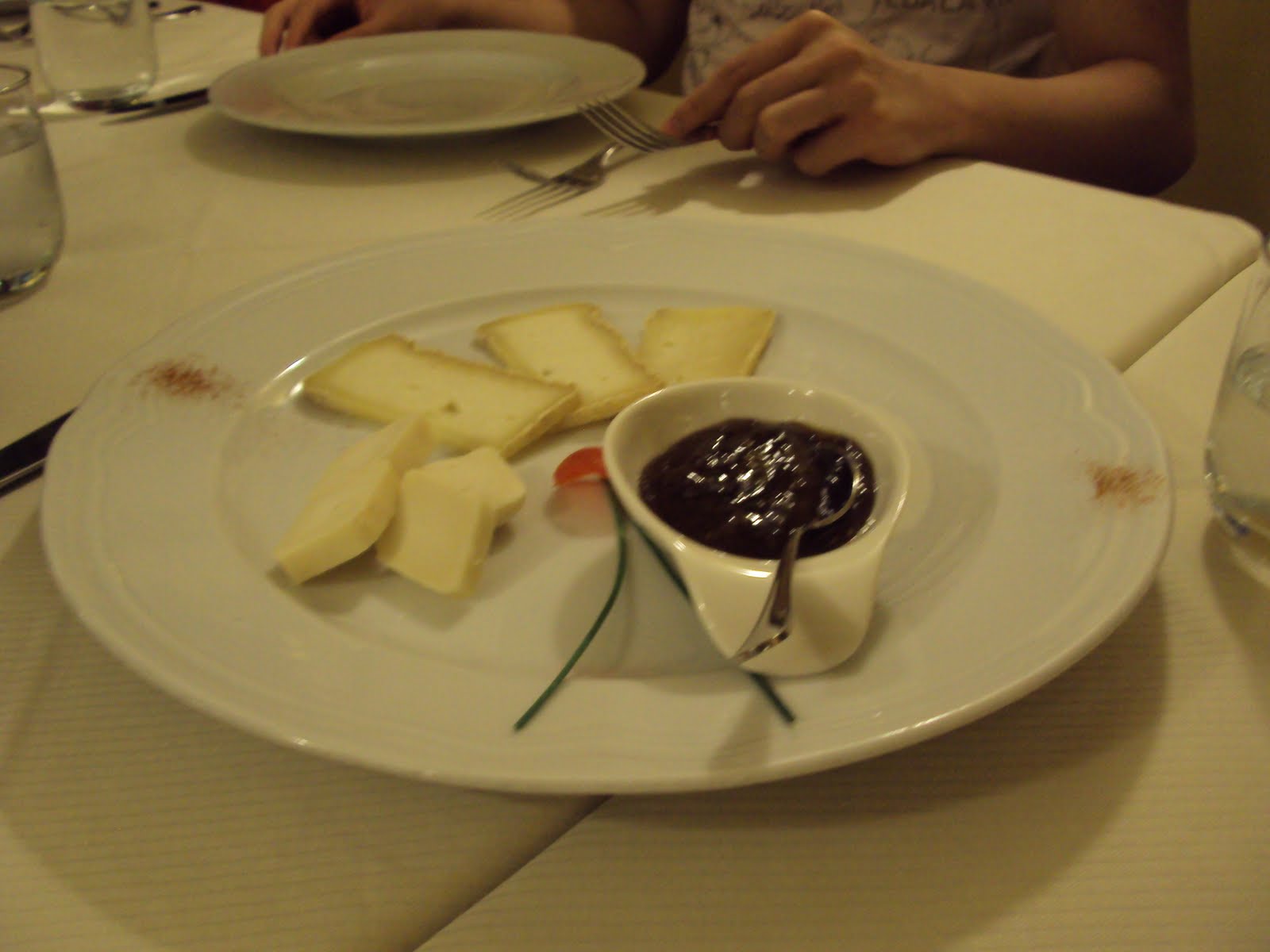
For the antipastis, we had caramelized onions with walnuts on baguette served with thin slices of wild boar sausages, home made cheese with a kind of jam on the side, and a vegetable cake baked in a tureen with eggs. We then shared 2 pasta dishes, the first was sphagetti with chesse fondue and bacon and the second one was sphagetti with a tapenade of tomatoes, olives and anchovies.


For the main dish we shared a chicken with pepper sauce and the signature dish of the house, pork shoulder stewed in fruits, vegetables and fish sauce which according to our host  was a recipe originally created by Julius Caesar's chef, Gaius Matius. And by the way, the fish sauce or garum as it was called then was made from crushed, innards or entrails of fish fermented in brine. Very similar to some varieties of fish sauce you find around South East Asia today. The antipastis, the pasta and the main dishes were fantastic, the girls were already impressed! But there was more to come! 


For dessert, we ordered ricotta in an almond brittle basket, capresse almond cake with a dark chocolate sauce and black cherries in an english cream sauce with almond crumble and a home made orange sauce. These were simply delicious!

The best of the night!

The nice thing about this restaurant is that the owner is very good at making everyone relax to the extent that you may even begin to  get the feeling that you are eating at a friend's house. He comes around once in a while checking up on you, at times offering wry, humorous comments. This guy is a perfect host! People sitting at nearby tables begin speaking to each other and most have come upon the recommendation of a friend or have read about this restaurant in different guidebooks, some listing this as one of 5 best restaurants in Rome. One of the guests at an adjacent table points to her guidebook and tells our host that he is famous...and he wryly comments, "after what we pay them....I should hope so!"


As you can very well see, we loved the food, the ambiance and the whole experience. So at this stage of our stay here in Rome, we have found a restaurant to which we will be returning regularly by ourselves and with our visitors and friends.

Friday, July 29, 2011

Orvieto

When visitors from home asked my husband and I to join them on a side trip to Orvieto, only an hour by train from Rome, we accepted the invitation with alacrity. We decided to take the morning train, which would get us to Orvieto a little before lunch and just in time to check into our B&B. While my husband, (the one who had to work) would take the afternoon train. We all woke up early and headed to the bus stop. We needed to take the Metro to Termini Station, where we would be taking the regional train to Orvieto. As we stood waiting for the bus with our suitcases, a kind man approaches us and tells us that there was a bus strike, and that all buses and trains were not running on this day. We stood there stunned for a moment and then returned to the apartment. Being intrepid travellers, thoughts of not proceeding to Orvieto lasted but a minute, after which we all scrambled to look for an alternative way to get there. We were lucky enough to find a tour van with 2 women going to Florence, who were willing to drop us off in Orvieto, if we shared the cost with them and if we left right then and there. The only hitch was my husband had a meeting until 2 that afternoon, but he kindly offered to stay behind. Being a “dutiful” dependent spouse, I offered to stay with him. But the rest of the group would not hear of this, clearing a two o’clock departure from Rome with the women going to Florence.

 After a little over an hour’s drive on the highway to Florence, Orvieto suddenly comes into view lying on top of almost vertical cliffs still surrounded in some parts by defensive walls. The cliffs, I found out later were part of a tufa plateau formed by the eruption of the Volsinii Volcanoes and the walls which were built right on them made use of the same material. It is quite an impressive sight!

There are three ways to get up to Orvieto, the first is via the funicolare, the cable car which is found right beside the train station, the next is by using stairs and escalators and the third is driving up.


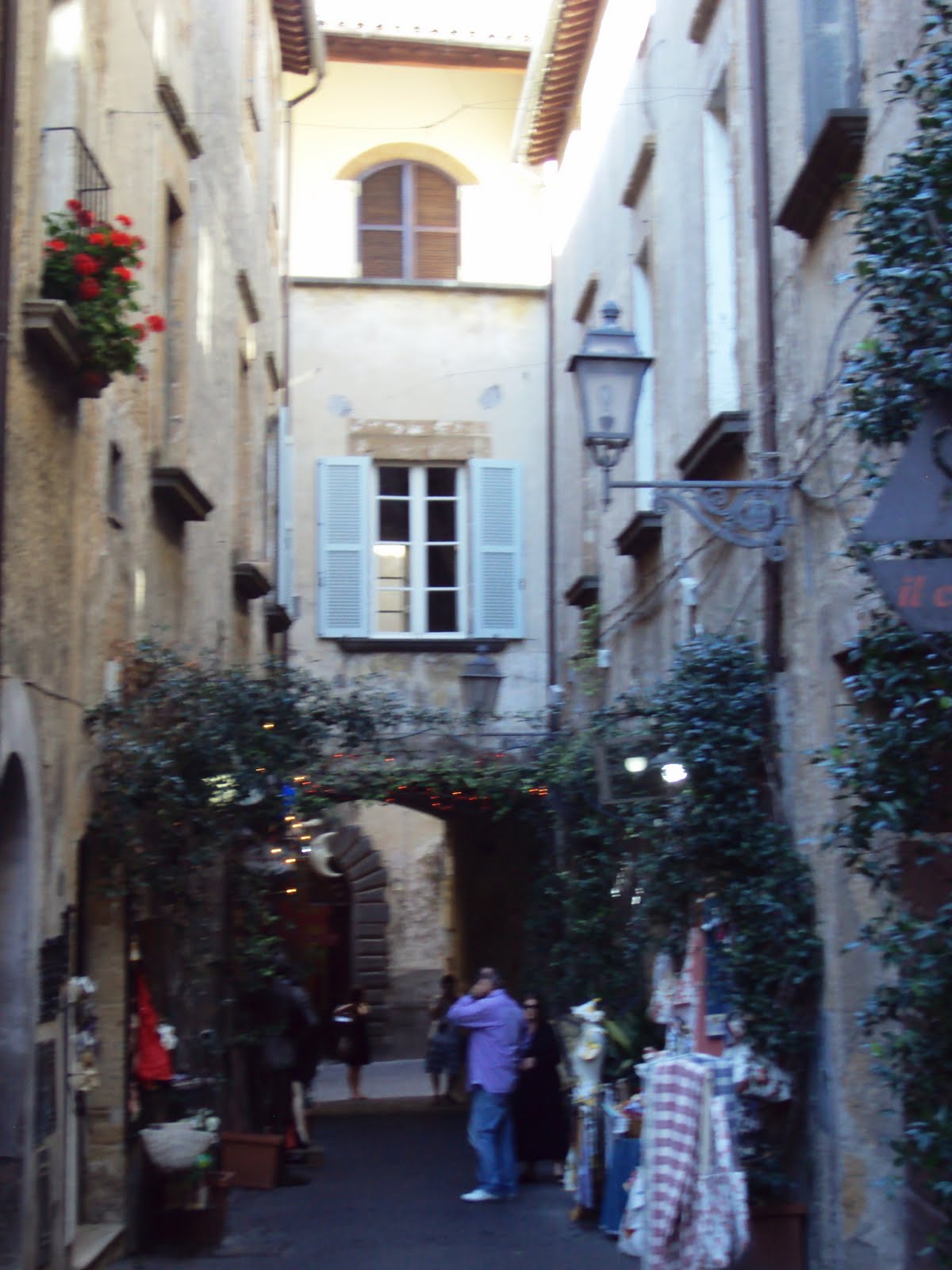
Our driver kindly deposited us beside the station of the funicolare at the top and from there we dragged our suitcases to Valentina’s Bed and Breakfast. Located on Via Vivaria, a charming narrow cobblestoned street, we were given 3 very comfortable apartments with a well appointed common area, a veranda that let in a nice breeze and a coffee machine that churned out cups and cups of delicious Italian coffee! Valentina herself welcomed us and brought us to our accommodations, making sure that we had everything we needed. She was gracious and very helpful even making dinner reservations for us.

Orvieto is a charming town of picturesque piazzas, small quaint streets that lead you to some rather impressive sights. The most impressive of these is the Cathedral, which many consider one of Italy’s grandest. Located in the Piazza Duomo, it’s origins are attributed to a doubting priest, a white cloth and a spot of blood. A priest, whose name may have been Peter (no not Thomas) was said to have had doubts that a piece of bread could truly become the Body of Christ during the celebration of the Holy Mass. But as the story goes, one day as he was raising the host during the consecration a spot of blood from the host dripped onto the white altar cloth. Needless to say, he became a believer and brought the cloth to Pope Urban IV who was staying at Orvieto at the time. Unlike Peter the priest, Pope Urban was a true believer, declared a miracle and promised to build a cathedral in Orvieto to house this relic. And that as they say was that. The feast of Corpus Christi was declared and is the most celebrated feast in Orvieto to this day. As for Urban’s promise, the building of this magnificent cathedral was begun.

The Cathedral is impressive, not only because of the sheer size of it but also because of the splendour of it’s facade which contrasts with the impressive yet simplicity of its sides. Looking at the facade, one can understand why it is called by some “The Golden Lily of Cathedrals”, adorned as it is with bas relief panels, mosaics, sculptures, towering Gothic spires and the rose window right at the center.

On the other hand, the sides of the cathedral are built with alternating rows of basalt and travertine blocks which give it a stripped appearance, simple and elegant.

The interior is built with the same material and design in the Gothic style with it’s pointed arches soaring upward. The main altar is dominated by a beautiful stained glass window directly behind it standing between panels of frescoes along both sides. There are two side chapels, the San Brizio Chapel is completely covered with frescoes while the Chapel of the Blessed Corporal houses the reliquary made of silver and enamel which is suppose to house the remnants of the miraculous host.

The Piazza Duomo on which the Cathedral stands is a pretty little square with small cafes and stores and the Torre de Maurizio with a bronzed automation (a turbaned man) striking a bell to mark the time, every fifteen minutes.

Around and beyond the Duomo is a warren of picturesque, narrow streets, of apartments and shops selling crafts, food stuff and Orvieto’s special white wine. There is so much to see of Orvieto that before we knew it we had to go back to our room to change for dinner.

We had an excellent dinner at the Osteria Numero Uno (which I will tell you about at another time) and then strolled down the walkway along the cliffs before calling it a night.


The next morning we woke up early to go to the Saturday market in the piazza. This market sells fresh produce like vegetables, fruits, cheese, hams etc. and also dry goods like shirts, dresses, nightgowns, handbags and many, many more. There was even a man selling different kinds of honey made during the different seasons of the year. 

We bought a lot of fruits, prosciutto and bread for breakfast and brought it back to the common area in our B&B. Everyone ate heartily, each drinking several cups of coffee of one’s preference (espresso, cappuccino, macchiato .... you get the idea). After this we all agreed to meet back at the B&B by 11:30 to check out and take the bus from the Piazza Duomo to the foniculare.

Staying overnight in Orvieto (arriving only in the afternoon) is really not enough, because the town itself is so interesting there was no time to visit the museums. What I really wanted to see was the underground city but unfortunately the tours only started at 11 am which was too late for me that Saturday morning and ended at 3 pm which was too early for me having arrived at 3:30 the afternoon before. Is Orvieto worth another visit? I think so!