Favorite Photos

Favorite Photos
Bernini's Ecstasy of St. Teresa

Tuesday, July 26, 2011

Iconic Structures of Rome: The Pantheon

I have visited the Pantheon three times since I arrived in Rome and I know I will be visiting it again and again before I leave. Some consider the Pantheon the preeminent architectural feat of ancient Rome, and I can understand why! I approached the Pantheon from the via di Minerva, seeing GianLorenzo Bernini's statue of a playful baby elephant affectionately known as "little Chick", seeing the Pantheon from it's side and then walked around to the front.

It was completed sometime in 125 AD under the Emperor Hadrian and was built atop an older structure (27BC) by Marcus Agrippa, Augustus Caesar’s son-in-law and military commander. Hadrian honoured Agrippa by placing this inscription on the frieze of the portico – M*AGRIPPA*L*F*COS*TERTIUM*FECIT.

The Pantheon was a temple honouring the 12 most important classical gods of Rome: Jupiter, Juno, Neptune, Bacchus, Apollo, Diana, Mercury, Minerva, Mars, Venus, Vulcan and Ceres. In 609 AD, the Pantheon was consecrated as a catholic church, Sta. Maria ai Martiri, which may have helped preserve it. That did not prevent Pope Urban VIII, a thousand years later, from stripping the bronze roof from the ceiling of the portico and melting it down for the baldachino at St. Peter’s and the cannons of the Castel Sant’Angelo.

The Pantheon was built on the Campus Martius or the ancient Field of Mars. Today the Pantheon is on the southern edge of the Piazza della Rotonda, considered by some to be one of Rome’s more picturesque squares with the pre-requisite fountain in the middle and yet another obelisk. The Piazza is always crowded, with people sitting in the cafes, hawkers pushing their wares, street musicians performing cacophonously, faux centurions offering themselves to be photographed, boxed in by buildings, and littered with debris, giving it an air of lively decrepitude, but somehow not detracting from the magnificence of the Pantheon.

Walking into and seeing the Pantheon that first time that first week in Rome literally blew my mind! The simplicity of the structure, the wide open circular space, the dome with the oculus through which the sun’s light came through was just breath-taking, an uplifting, maybe even religious experience! The hordes of people did not detract from the experience but did fuel a resolve to come at some other time, numerous times if need be to experience this place under more peaceful circumstances.

Sitting down underneath the oculus, I remember the information: the height and diameter of the dome are an identical 43 meters, creating a perfect sphere, apparently a symbol of spiritual perfection. The dome is also thinner on the top and has an occulus to enable the base to support it's weight. The occulus is 9 meters in diameter allowing the sunlight in, through which you also see the sky. The occulus and the doors are the only sources of natural light and the  light through the occulus moves in a reverse sundial effect. Looking up at the occulus can be mesmerizing, be careful though lest you leave the Pantheon with a stiff neck!


The interior design is dominated by squares and circles. The floor has a checkerboard pattern, while the ceiling is adorned with concentric circles of squares. Directly underneath the dome are niches which at one time may have contained the statues of gods.
Then one sees the columns, the high altar and the apses. In addition there are three niches and three chapels. King Victor Emmanuel II is buried in the second chapel and Raphael, the painter is buried in the third niche near the third chapel.

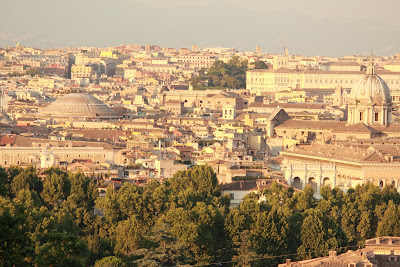
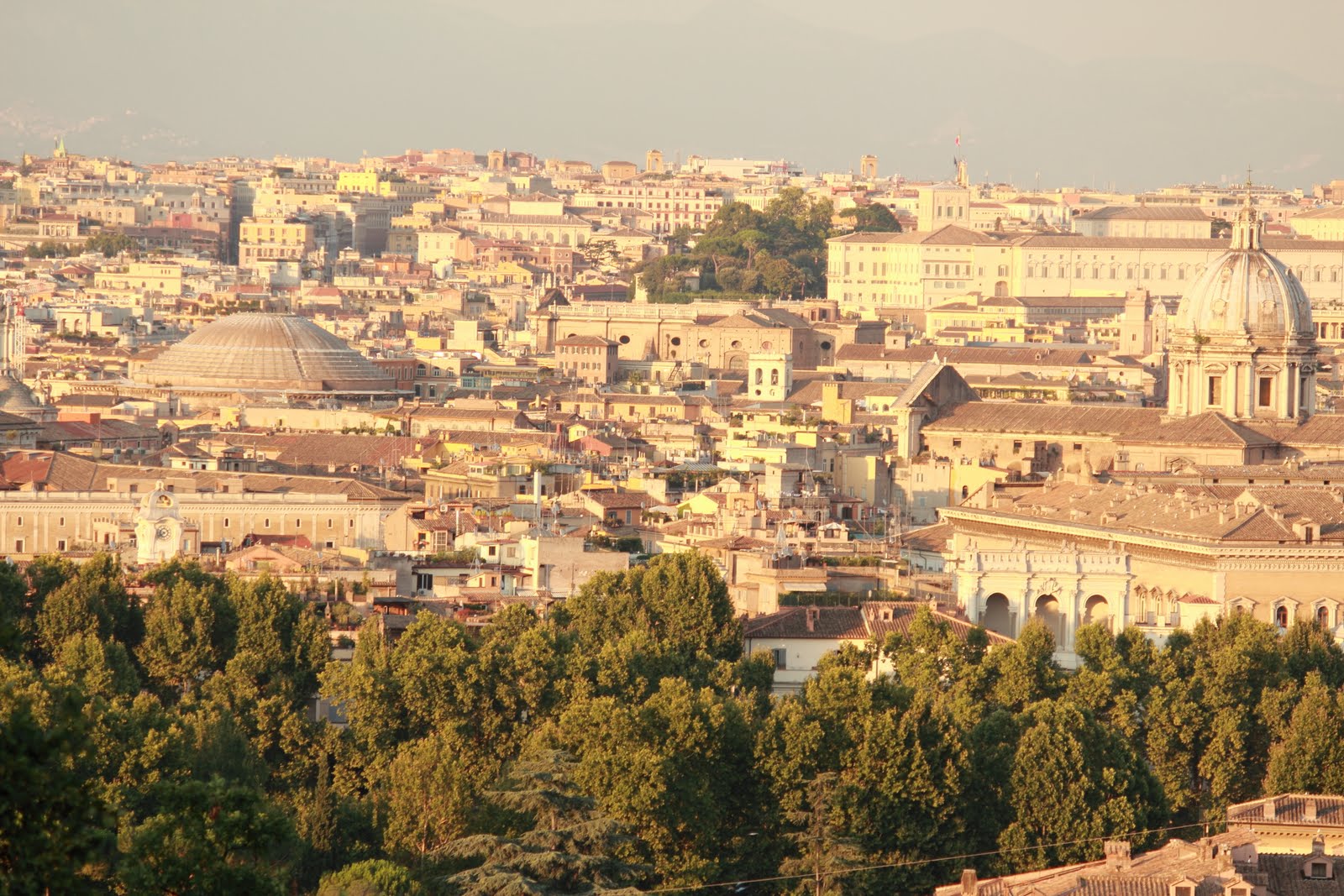
Reading accounts of travellers to Rome modern and from long ago, it becomes apparent that the sight of the Pantheon has been and will continue to be an awe-inspiring sight! And as if to underline it's uniqueness, even in this city of mind-blowing sights, it can be seen easily in any panoramic view of the city, resembling an upside down chinese bowl, unique in this city of domes.

Friday, July 22, 2011

PIZZA!

I’m sure most of you have eaten an oven baked, flat, disk shaped bread topped with tomato sauce, cheese and various toppings sometime in the past month? If you’ve eaten a pizza, then yes you have! Here in Rome there may be as many pizzerias as there are churches...or maybe even more! At any time of day you can enter one of these pizzerias and get a pizza to go. These are what is known locally as the pizza al taglio, rectangular shaped pizzas, with a wide variety of toppings and sold by weight. When you enter one of these places, you see a counter with different types of pizzas. You point at what you want; the person behind the counter will get his sharp pizza cutter, place it at a certain point on the pizza and will look at you. If you shake your head, he’ll move it further down, when you nod your head, he will proceed to cut that portion for you. He weighs this on his weighing scale right there on the counter and then cuts it in half and puts it together with the filled side facing each other (sandwich style) and wraps it up. Eating pizza this way as one walks around or sits at a curb side is a common sight. This brings the pizza back to its origins as a “street food”.

Scoglio di Frisio, a restaurant on Via Merulana which first opened its doors in 1928 and still owned and ran by the same family offers pizza making courses. Family members on holiday in Rome and I decided that learning to make pizza here in the Land of The Pizza would be a fun family thing to do, so we attended the restaurant’s one day course. The present owner of the restaurant himself welcomed us and gave us a mini lecture on the origins and the principles of making pizza. As he spoke, it became obvious to us that here was a man who was not only passionate about what he did but also loved and enjoyed it!

As our host explained it there are three major ingredients in pizza, the first is the tomato. Flat breads, like naan, pita, focaccia and many others have been part of traditional diets all over the world. In Italy the focaccia became the pizza when tomatoes were added as a topping. Tomatoes came from the Americas in the 16th century. The pomodoro or “golden bowl” was for the better part of 200 years, considered a decorative plant. Sometime in the 1830s, a poor woman in Naples decided to add the pomodoro to her bread and created the pizza. These “pizzas” were sold from open air stands and were considered “poor man’s food”.

The second major ingredient is olive oil. This “golden liquid” was used from prehistoric times in and around the Mediterranean basin as seen from the discovery of amphorae, the earliest of which was dated 3,500BC, used to contain this has been found.  Olive oil came to southern Italy around the 8th century BC. Before olive oil, animal fat was the oil used for cooking, but with the advent of olive oil, vegetable fat came into favour and the Italians acquired the Mediterranean “mentality” in terms of their food preparation.

The third very important ingredient in any pizza is salt. Salt was a valued item as it was essential in preserving food and thus eliminating dependence on seasonal availability. Some have called salt the foundation of civilization. It was very difficult to obtain and was therefore a very valued trade item. In Italy, legend has the Via Salaria an ancient road being built by men who were paid in salt (thus the origins of the word salary) for their work. Historical accounts however, say that this road was so called because the Sabines, the original “salt merchants” used this route to fetch salt from the marches around the Tiber. No matter which account you prefer, Via Salaria was apparently already in existence in the Bronze Age.

The modern pizza made its appearance as the Pizza Napoletana, which was simply the pizza pie with tomato to which cheese was added in 1889. According to our host, King Ferdinand used to visit the poor neighbourhoods in Naples in disguise just to eat this.

When Queen Margherita of Savoy visited Naples in 1889, a Neapolitan chef, Raffaele Esposito created a pizza with tomatoes, mozzarella cheese and basil to represent the colors of the Italian flag, in her honor. This pizza came to be known as Pizza Margherita.

According to our host, there are only two true Napoletana pizzas, they are the Marinara which contains tomato, oregano, garlic and extra virgin olive oil (no sea food) and the Margherita which contains tomato, mozzarella and basil. To be considered true Napoletana Pizzas, these rules of the True Napoletana Pizza Association must be followed:
1.      Must be baked in wood fired domed oven at 485 degreesC for no more than 60-90 seconds
2.      Base must be hand kneaded and must not be rolled with a pin or prepared by any mechanical means
3.      Must not exceed 35 cm in diameter or more than 1/3 of a cm thick at the center

After all these interesting facts, it was down to business for us. So we donned our aprons and chef’s hats and proceeded to the workstation of the pizzaiolo (the pizza chef). The first thing he explained to us was that the flour he used was flour for pizza which he said could be wheat flour which is at least 3 months old so that it has no residual moisture left. He then measured flour, water, oil and salt and proceeded to incorporate them.

Incorporating the olive oil, yeast, water and flour is an art in itself. First make a very large well in the center of the mound of flour, basically pushing all the flour to the sides forming a circular wall of flour around where you add the liquid and slowly with your fingers bring in the flour gradually until you can gather it into a ball, then push the remaining flour to the sides and start the kneading process. This is the physical part of pizza making where you fold the dough in and then push out with the palm of your hands until the dough is pliable and no longer sticks to your fingers. When we asked him how long we had to do this, he says “no time, you need to feel when it’s right!”

When the dough “feels right” you then cover with a damp cloth and make it rise. Asked as to how long we should make it rise, he again replied “no time, you need to feel”. Basically it is done when you push a finger into the dough and it makes an indentation and doesn’t spring back.

After this, you need to transform the ball of dough into a flat circular shaped pie and again this is done with your hands. We all had a hand at this, and even if ours didn’t come out as circular as his did, they still looked pretty, to us at least.


Then tomato sauce is spread on top. The tomato sauce is simply canned tomatoes, remove the seeds, squash all of them and add some olive oil and some salt. Then the toppings are added, whatever you want and then last, the mozzarella cheese. Drizzle a little bit of olive oil on the top and put it into the wood fired oven which has a temperature of 485 degrees centigrade for no more than 60 to 90 seconds. For our home ovens we would need to first put the tomato sauce on the pie, put that in the oven (at its highest setting) for 10 minutes, remove from the oven, add the toppings and the cheese and olive oil and return to the oven for another 5 minutes.

The demo pizza made by our pizzaiolo was a Napoletana pizza, with a soft pliable thin crust. He told us that in Rome they preferred a thin crusty crust, using only 80 grams of dough as compared to 250 grams.

So, where our pizza’s true Napoletana pizzas? They were hand kneaded and hand rolled, they were baked for no more than 90 seconds in the restaurant pizza oven and were more or less round, so conforming to the basic requirements. However, free to add whatever toppings we wanted...we strayed from the 2 true Napoletana pizzas, adding artichokes, prosciutto, mushrooms...you get the idea. Then the final test which we were told was the most important, “rely not on the eyes but on the nose”. Smelling our pizzas after they came out of the oven.... hmmm.....yes.... they passed the test for sure!

Sunday, July 17, 2011

Photographs....Who's Who

Because of the nature of my husband's work, we have had to make a couple of major moves which meant transfering our entire household from one country to another. Moving meant packing, and any of you who have had to move knows how tedious that can be. In my case, there was one thing that would invariably delay the packing. Coming across photographs, boxes and boxes of photographs, would result in a whole afternoon of packing set aside! I like taking pictures, I like looking at pictures even more. Every time, I came across those boxes, I could not resist looking through them. The boxes have grown exponentially, so the time it takes to “look through” them has also taken much longer. I don’t go through these photographs by myself; it’s become a shared “family experience”. Seeing these photographs makes us relive portions of our lives and seeing pictures of people we know or used to know reacquaints us with them.

The ancient Romans were not so very different, they also “took” photographs. The first attempts at “photographing” were wax masks taken of deceased persons. The ancient Romans kept these masks, usually of their ancestors in special niches in the walls of their homes. After this, materials like terracotta, bronze and then finally marble were used to produce these portraits or busts.

I have been taking pictures of a lot of these busts and have enjoyed putting a face to the name, names familiar to us through our history lessons. For this blog post I am going to do a who’s who, a gallery of the portraits of the more important people from the Roman Republic until the Age of the Antonines. A bit of history is unavoidable, so I hope you bear with me.

No other persons to start with but Romulus and Remus, the founders of Rome. Legend has it that they were children of the god Mars and Rhea Silva, whose uncle ousted Rhea’s father from the throne forcing Rhea to set her twins adrift on the Tiber. They were rescued by a she wolf that suckled them until found by a farmer who raised them. Romulus founded Rome on the Palatine Hill based on an augury contest he won over Remus who wanted to build Rome on the Aventine Hill. The only photograph we have of the brothers is as infants.... ;)


Romulus ushered in the era of the Kings, seven of them in all. The republic followed the ouster of the last king. There was a period of expansion followed by a series of Punic wars until Hannibal was defeated by Publius Cornelius Scipio Africanus, so called, not because he was from Africa (bust was carved on black marble), but because he defeated Hannibal in Africa.

After this, the Roman Republic would face a crisis, culminating in the civil war between Marius, a “new man”, and Lucius Cornelius Sulla, an aristocrat. Sulla prevailed and became dictator. Can you tell who’s who?

After Sulla’s death, the First Triumvirate came into being, composed of Crassus, Pompey and Julius Caesar. Crassus was known as the richest man in Rome and as the man who put down the revolt of slaves led by Spartacus. He backed Caesar but was killed in Syria.


Pompey or Gnaeus Pompeius Magnus led successful military campaigns and was granted the cognomen, “the great” by Sulla. He married Julia, the daughter of Julius Caesar to seal the alliance between them. But when Crassus died, he sided with the senators against Julius Caesar and a civil war ensued. Caesar defeated him at the battle of Pharsalus. Pompey sought refuge in Egypt where he was instead assassinated.

Julius Caesar conquered Gaul, crossed the Rubicon in defiance of the Roman Senate and became dictator for life. But as we all know, he was assassinated by a group of conspirators led by Brutus and Crassus on the Ides of March. But before this he and Cleopatra had a son, Caesarion. The Egyptians also had their own way of "photographing".


Julius Caesar adopted Octavian, his nephew and made him his heir. Octavian defeated Mark Anthony and Cleopatra at the Battle of Actium, and so began the Imperial Age. He was given the name Augustus and reined for over 40 years. He was married to Livia, but they had no children.

The death of Augustus ushered in the Julio-Claudian dynasty, which was marked by a series of palace conspiracies, intrigues, poisonings and assassinations. Tiberius, the son of Livia with her first husband became emperor after the death of Augustus. His reign started well enough but towards the end, he spent more time in his palace in Capri reputedly indulging the more prurient aspects of his sexual appetites.

Caligula, Gaius Julius Caesar Augustus Germanicus was a nephew of Tiberius. As a child Caligula was affectionately called “Little Boots” by the troops of his father, Germanicus. Designated Tiberius’ heir, he stayed with Tiberius in Capri from a young age. His reign was remembered for its extravagance and Caligula for his cruelty and sexual perversities. He was assassinated by his own praetorian guards who proclaimed his uncle, Claudius, emperor.

Claudius was the brother of Germanicus and was afflicted with a limp and slight deafness and as such he was never expected to succeed to the throne. This defect may have also kept him safe from the intrigues that were rife in the family of Augustus. He adopted Nero, the son of Agrippina the younger sister of Caligula.

Nero succeeded Claudius. He built the Domus Aurea on the site of the Palatine that had been destroyed by the Great Fire. There are many stories relating to Nero the more notorious was he had had his mother killed and that he had a hand in starting the Great Fire, because he wanted to rebuild Rome in his image. And legend has him playing the fiddle as Rome burnt.

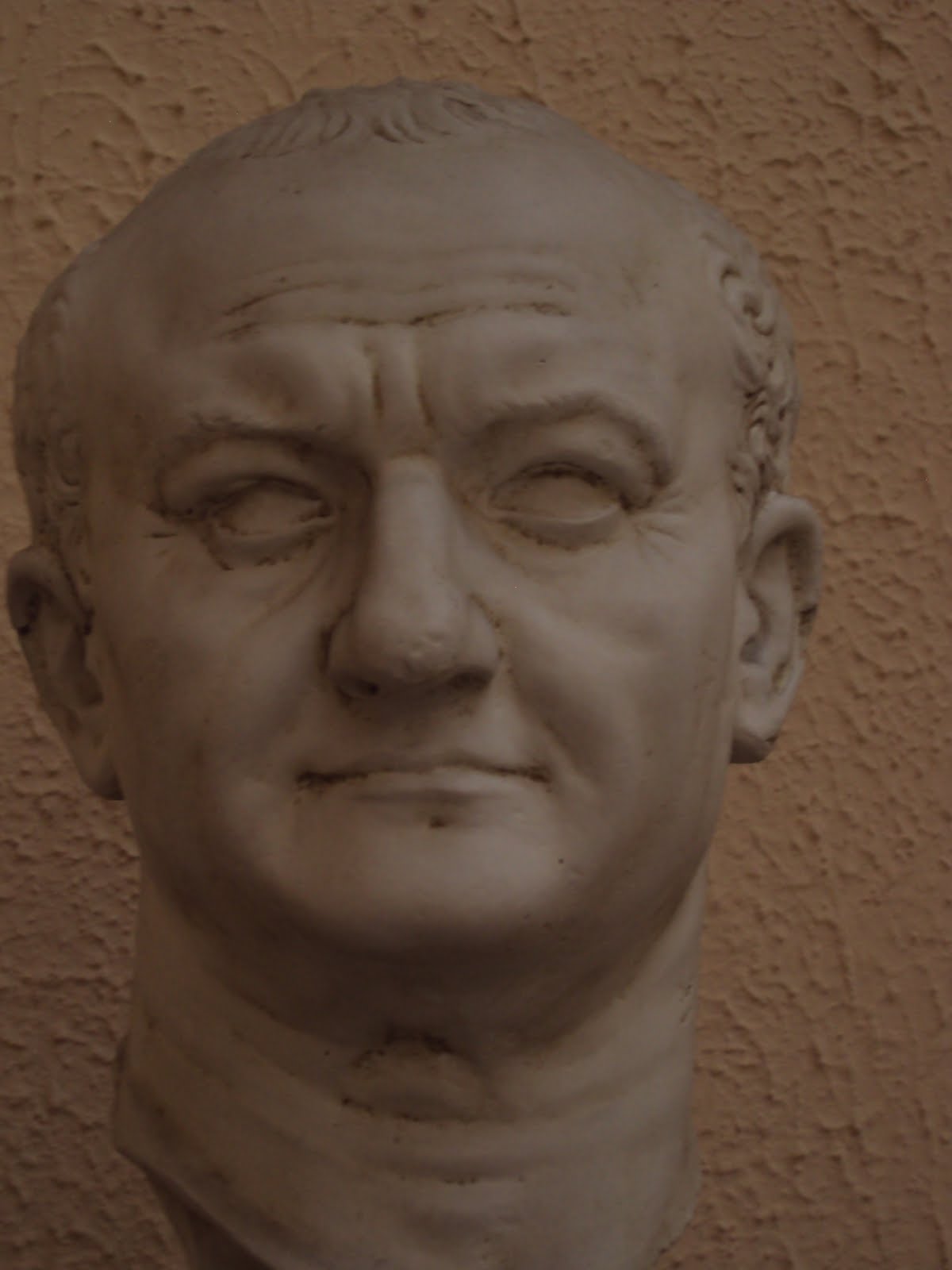
After Nero’s death there was a period of instability where four emperors followed one after the other until Vespasian, with the support of his legions in Judea became emperor, beginning the Flavian Dynasty. He started the construction of the Coliseum.


Titus, Vespasian’s son succeeded him and completed the building of the Coliseum. He was an able administrator but he had a short reign, dying suddenly after only two years.


Domitian, Titus’ brother succeeded him. Domitian continued the buildings started by his brother and father in the Field of Mars. However, he was despotic and hated by the senators who assassinated him. (These Flavians sure looked alike!)


The senators named Nerva, another senator to replace Domitian. Nerva began the principle of adoptive succession to the post of emperor, where the successor was chosen from outside one’s family and based on political and military talents. He was the first of the five "good emperors".


Nerva appointed Trajan, a Spaniard to be his successor. Trajan was given the title of optimus princeps, most excellent prince and his reign came to be known in history as a golden age. Trajan’s military victory over the Dacians is immortalized in Trajan’s column which is still visible today. He was married to Plotina.

Hadrian, another Spaniard succeeded Trajan. He did not seek to expand the empire, satisfied to consolidate the empire’s existing territories. He has left us, among other monuments, his mausoleum, the Castel Sant’Angelo, to marvel at today.


Antoninus Pius succeeded Hadrian, who adopted Marcus Aurelius and Lucius Verus and designated both to succeed him. Like Hadrian he pursued a policy of peace.


Marcus Aurelius succeeded Antoninus and shared power with his brother Lucius Verus, until the latter's death. At this time, the empire was rocked by revolts from some of the vassal states and Marcus Aurelius proved this military prowess by putting down these revolts. Today, he is remembered as one of the more important Stoic philosophers (Meditations of Marcus Aurelius). He was the last of the five "good emperors". He abandoned the principle of adoptive succession and returned to dynastic succession.

Commodus (the emperor in the movie Gladiator, who did fight gladiators in the arena, but always ensured, undoubtedly by foul means, that  he would be victorious), Marcus Aurelius son succeeded him. He restored the autocratic system of government and distinguished himself for his ambition and cruelty. He assumed the title “Roman Hercules”


These portraits, and many more like them, give history a face. Seeing them “in the flesh” so to speak brings home the fact that these bigger than life people really lived. Legends may have grown around them but in the end they were men and women, products of their time, and just like us coping with life’s challenges and rewards in their own inimitable ways.

And by the way, bringing my boxes of photographs around is nothing compared to what the Romans had to do to bring their photographs around! As for me, no more boxes .... technology to the rescue....this is how I bring my photographs around these days.  


Thursday, July 14, 2011

Search for Caravaggio Continued

My continuing search for Caravaggio brought me to the Palazzo Doria Pamphilj on Via Corso, where I came across, two paintings which showed yet another facet of Caravaggio.

This Palazzo is still the home (they live in a part of it) of the Doria Pamphilj family, one of Rome’s most illustrious. The family is descended from Pope Innocent X Pamphilij, to whom is credited the beginning of its fortunes, while Prince Camilo Pamphilij is credited with collecting a considerable portion of the art, paintings, bust, statuary, including the incorrupt body of St. Theodora and the relic of St. Justin (which you can actually see in the palace chapel) found in the palace today.

Palazzio courtyard with lemon trees
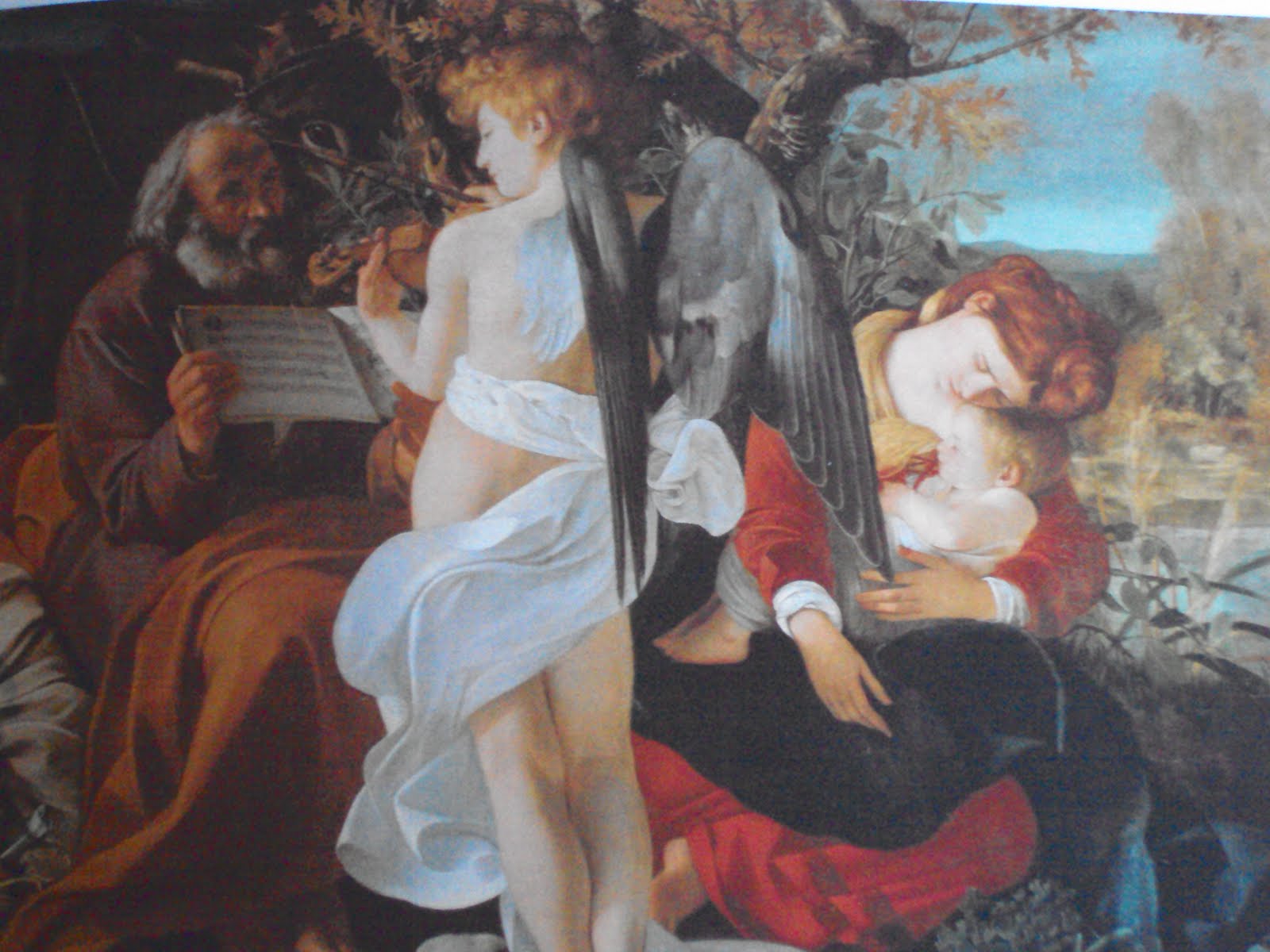
The picture gallery of the Palazzo Pamphilj extends around a lush courtyard and the paintings are stacked one on top of each other and side by side. Contained in this collection are many masterpieces and among these, you find two of Caravaggio’s earlier works, The Repentant Magdalene and Rest on the Flight Into Egypt. 


from ATS Italia Editrice

The Repentant Magdalene (1594-1596)  Despite commentaries on this painting identifying it as Mary Magdalene because of the long hair and the vessel of oil on the floor beside her, I see it as a painting of a young girl in tears over a set of broken beads, the portrayal of this is done so movingly, so  touchingly, making one witness .... remember? rather poignantly, heartaches of the very young. The scene is peaceful, and tranquil despite the tears. The colours though vivid and bright are soft. Even the shadows are subdued. The subdued tone displays the delicacy of the emotion which paradoxically for me at least, comes across as more intense than the dramatics of his later paintings.


from ATS Italia Editrice

Rest on the Flight to Egypt (1594-1596) This is Caravaggio’s first painting of a biblical subject. It features the Holy Family resting on their way to Egypt, as they flee from Herod. It shows a peaceful, tranquil scene with Mary and the Child sleeping while an angel plays the violin to a score held by St. Joseph. They are sheltering under a tree surrounded by foliage that is detailed, accurate and very delicate. The background landscape is very naturalistic, the colors are soft and shadows subdued.

After seeing these paintings, I came across additional information on Caravaggio that I had to grapple with. Andrew Graham Dixon, in his book on Caravaggio entitled; Caravaggio: A Life Sacred and Profane, uncovers additional, rather unsavoury aspects of Caravaggio’s life and character. Based on in-depth perusal of documents, including court documents, pertaining to incidents in Caravaggio’s life, Dixon suggests that Caravaggio was sexually adventurous, may have worked as a pimp and may have had an illegitimate child. He also believes that Caravaggio did not die of malaria but because of injuries sustained from an attack he suffered outside a male brothel, while in exile in Naples. According to Dixon, after the killing in Rome, Caravaggio fled to Malta where he tried to become a Knight of Malta. He was admitted into the order after painting a large altar centerpiece for them. However, because of an altercation with another knight, he had to flee Malta and landed in Naples where he suffered his fatal injury.

Additional information of this nature has added to my confusion, my difficulty in accepting the paradox that was Caravaggio.  The talent was unparalleled, but the human being was ultimately flawed. This difficulty is not mine alone. Italian scientists announced sometime back that they had found what they believed to be the bones of Caravaggio, which contained very high levels of lead leading them to speculate that he may have been suffering from lead poisoning, thus explaining his erratic and violent behaviours. There is some credence to this because paints and pigments used at the time contained high levels of lead. The “madness” of Van Gough was also attributed by some to lead poisoning. However, these scientists had to recant the announcement when it was discovered that the bones examined could not have been Caravaggio’s.

Undoubtedly, his temper was explosive and whether the murder of Renuccio Tomassioni was due to a disputed tennis score or as Graham-Dixon suggested a matter of love, jealousy and uncontrollable lust for a  prostitute, Lavinia, who reputedly bore him a son, it certainly points to an uncontrollable impulsivity resulting in extreme acts of violence. And tortured by guilt does he try to atone for this through his paintings? Are some of his paintings an expression of guilt? Or maybe a plea for forgiveness?


from ATS Italia Editrice

 David with the Head of Goliath. This was painted for Cardinal Borghese between 1609-1610, and is found in the Galleria Borghese. If you look closely, he painted his own face on the head of Goliath. The expression to me in David’s face is neither triumphant nor victorious, it is merely sad. Caravaggio sent this work to the pope hoping to secure his pardon for the murder.


Caravaggio from Wikipedia

I’ve come to appreciate that fully understanding Caravaggio the man may not be possible at this point in time, centuries after the fact, but one thing sure is that he has left us unforgettable images and those we can understand on our terms, we can marvel at, and enjoy!

Monday, July 11, 2011

Churches of Rome: Basilica of San Clemente

According to Wikipedia, there are almost 900 hundred churches in Rome. When you walk the streets, in any neighbourhood, no matter how small, you will, without fail, come across a church or two or three. I have entered quite a number of these churches, large and small, so many actually that they have began to merge together. But one small church located close to the Colosseum, along St. John Latern Road is a stand-out! The Basilica of St. Clement is a small, understated, but decidedly elegant church. It was named after Pope St. Clement, who died about 100 AD, and was the third successor of St. Peter in the See of Rome. Not only is the church beautiful, in my opinion, but also, no other church can rival its history. The walls of San Clemente enclose three separate places of worship built one on top of the other, spanning a period of over two thousand years!


Courtyard of San Clemente

Walking into this church is very different from entering a lot of others. Entering through the main entrance, you first step into a small, peaceful, courtyard with an unpretentious fountain in the middle. 


Interior of San Clemente
The church at the ground level is a medieval basilica, with beautiful cosmatesque floors, reputedly done by the Cosmati brothers themselves, the Cosmati family being the leading marble craftsmen creating this geometric decorative inlaid type of stonework. In front of the altar, the choir is separated from the rest of the congregation by a white marble enclosure bearing the earliest papal insignia, that of John II.


Tree of Life mosaic

Then you see the beautiful Tree of life mosaic from the 1180s on the apse. This depicts the Triumph of the cross, expressed with perfection through colored stone and glass! Truly magnificent!


On the right side, the newly restored chapel of St. Catharine feature frescoes in soft pastel colors of scenes in the life of St. Catharine.


Fresco Madonna and Child


Entering the bookshop, after paying the entrance fee, you proceed down to the excavations. The lower level features the 4th century church. You can walk through the church, encountering frescoes illustrating the life of St. Clemens, a mosaic of St. Cyril in the nave of the church and on the North aisle a Byzantine Madonna and child on a niche, slightly to the left of a hole, reputedly through which in 1857, Fr. Joseph Mulooly, then prior of St. Clement, broke through to the 4th century church after excavations began.


Temple of Mithras

Going down to the next level, lit by florescent tubes, which casts everything in a rather spooky glow, you come upon a 2nd century temple to Mithras, a pre-Zoroastrian Persian god. Mithraism was a very secretive religion. Their temples were usually in caves or made to resemble caves. Little is known of this cult because of its secret nature. It is said that it emphasized loyalty, contacts and friendship between men, especially officers of the army and rulers. There were no known women followers. They were also known to share communal meals as seen from the remains of their temples.


Rooms of Roman House

As you go through this level, you hear the constant flow of water coming from the ancient sewer, the Cloaca Maxima which is still in use. Alongside the temple you can explore several rooms of a Roman house built after the fire of 64 A.D. I continued walking across a narrow alley which brought me to the ground floor rooms of this first century house. I stepped into the first room but the sound of rushing water, coupled with the eerie lighting, the dankness of the surrounding walls and the fact that the three people whom I thought were behind me had turned back, spooked me! I hurried after them!

Before leaving the church, I sat in one of the benches placed along the wall of the courtyard, where a cool breeze wafted through. Beside me, sat an American couple, after a period of silence the wife tells her husband, "this church I like". I agreed with her!